
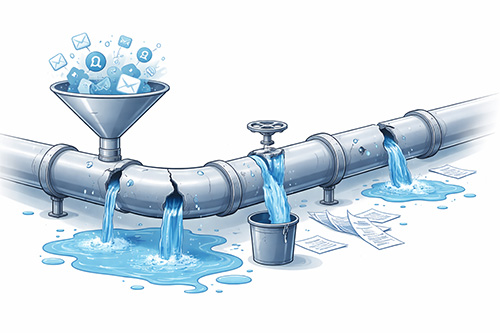

When businesses want to grow, the first instinct is usually to invest in marketing. Run more ads, launch a new campaign, hire a social media manager. But after overseeing operations and marketing delivery for hundreds of client engagements, I have learned that the businesses that grow most sustainably are not the ones with the biggest marketing budgets. They are the ones whose operations can actually support the growth that marketing generates.
Marketing without operational readiness is like turning on a firehose with no one holding it. You might get a flood of leads, but if your team cannot respond quickly, deliver consistently, or scale without breaking, those leads turn into missed opportunities and frustrated customers.
The Gap Between Marketing Promises and Operational Reality
Here is a scenario I have seen play out many times: a business launches a paid advertising campaign, drives a spike in inquiries, and then takes three days to follow up with leads. By that point, the prospect has already contacted a competitor and moved on.
Or a company invests in a beautiful website redesign that drives more traffic, but the sales team is still using a manual spreadsheet to track leads. Important inquiries slip through the cracks, and the return on that website investment looks far worse than it should.
The issue is not the marketing. The issue is that the operational infrastructure was not ready to handle what the marketing produced. According to a report from Harvard Business Review, companies that align their operations with their growth strategy outperform those that do not by a significant margin. The takeaway is straightforward: your operations need to be at least one step ahead of your marketing.
What Operational Readiness Actually Looks Like
Operational readiness for marketing is not about having perfect systems. It is about having the right systems in the right places. At a minimum, this means three things.
First, your lead response process needs to be fast and consistent. Whether a lead comes from a web form, a phone call, or a social media message, someone should respond within minutes, not hours. If you cannot do that with your current team, automate the initial response and build a workflow that routes leads to the right person.
Second, your delivery process needs to be documented and repeatable. If your business relies on a few key people who carry all the knowledge in their heads, you have a bottleneck that will break under growth pressure. Standard operating procedures, project management tools, and clear handoff processes make it possible to scale without sacrificing quality.
Third, your data systems need to talk to each other. When marketing, sales, and fulfillment use separate tools with no integration, you lose visibility into what is working and where things are falling apart. Even basic integrations between your CRM, email platform, and project management tool can dramatically improve how your team operates.
How to Align Operations and Marketing
The best approach I have found is to work backward from the customer experience. Map out every step a customer goes through, from the moment they first hear about your business to the point where they become a repeat buyer or referral source. Then ask: where are the handoff points, and which ones are fragile?
Those fragile handoff points are where growth breaks down. Maybe it is the gap between marketing-qualified leads and sales follow-up. Maybe it is the transition from sale to onboarding. Maybe it is the feedback loop between customer success and marketing that should inform future campaigns but does not exist yet.
Once you identify those gaps, fix them before you increase your marketing spend. You will get a better return on every marketing dollar when the machine behind it actually works smoothly.
The Competitive Advantage No One Talks About
In competitive markets, most businesses are running similar campaigns on similar channels with similar messaging. The real differentiator is not who has the cleverest ad copy. It is who can deliver the best experience after the click.
When your operations are tight, your response times are fast, your delivery is consistent, and your customers feel taken care of, marketing becomes easier. You get better reviews, more referrals, and higher lifetime value. And those outcomes create a compounding effect that no amount of ad spend can replicate on its own.
If your marketing is not producing the results you expect, do not just look at the campaigns. Look at what happens after the campaign does its job. That is usually where the real opportunity lives.
