
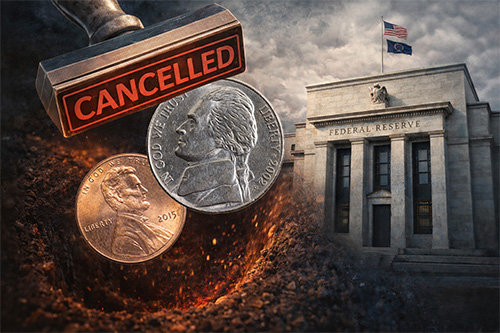

For more than a century, the American penny has carried a symbolism far greater than its monetary value. Children threw pennies into fountains, believing one coin could grant a wish. Pennies collected in piggy banks, car cup holders, and kitchen junk drawers. They connected generations through small rituals of saving, spending, and imagining what one cent could someday become. And then, in what felt like an overnight shift, the penny quietly disappeared from circulation, without the ceremony one might expect for an object woven into the fabric of American life.
The U.S. Mint’s decision to stop producing the penny was not a sentimental one. It was economic. The Mint had spent years operating at a loss on low-value coins, and the penny in particular had become a financial sinkhole. According to the U.S. Mint, each one-cent coin cost 3.69 cents to produce, driven by long-term increases in copper and zinc prices. A coin that costs nearly four times its face value to manufacture is unsustainable in any economy, especially one facing inflationary pressures and accelerating digital adoption. The penny had become not only inconvenient but fiscally irrational.
But the disappearance of the penny signals a deeper, more consequential question that is now quietly surfacing in policy circles, on Wall Street, and Main Street: If the penny is gone, what comes next? Will the nickel follow? What does this mean for small businesses, for legacy payment systems like paper checks and COD transactions, and ultimately for the future of American money? These questions invite us to examine far more than coins; they force us to reckon with a fundamental shift in how Americans think about value, transact, and connect to the financial system.
The end of the penny reflects decades of economic and technological movement. Economists from Harvard and former U.S. Treasury officials have argued for years that the penny had long outlived its usefulness. While the United States retained it out of habit, other nations moved ahead. Canada retired its penny in 2012. Australia and New Zealand phased out their lowest-denomination coins decades earlier. Even the European Union reevaluated its smallest coins as production costs rose. Meanwhile, in the United States, rising metal prices and inflation created a widening gap between a penny’s production cost and its spending power.
The nickel, now under the same economic pressures, finds itself in a precarious position. Producing one nickel costs more than nine cents today, a reality the U.S. Mint has acknowledged as increasingly unsustainable. A recent McKinsey analysis on modernizing national currency systems notes that low-value coins are the first to disappear in countries experiencing rapid transitions toward digital payments. This is not simply theoretical; consumer behavior in the United States already points toward diminished reliance on physical change. Many vending machines no longer accept nickels. Retailers often round transactions for customers who pay in cash. And consumers, who long ago traded coin jars for digital wallets, barely notice the loss.
If inflation continues and raw material prices remain high, the nickel’s retirement could arrive much sooner than many expect. Some economists forecast its elimination within the decade. Others envision a future where all coins under 25 cents eventually disappear, replaced by digital transactions and streamlined pricing models. Once the penny fell, the domino effect became easier to imagine.
This shift has real implications for American businesses, especially small businesses that still rely on cash transactions, paper checks, and COD (Cash on Delivery) practices. Eliminating low-value coins reshapes how prices are set, how cash drawers reconcile each night, and how customers pay in sectors where cash still plays a role. For businesses operating on thin margins, even small operational changes carry meaningful weight.
Without pennies, businesses have already begun rounding transactions to the nearest nickel. Should the nickel disappear next, the rounding convention would move to the nearest dime, affecting cash-heavy businesses like corner stores, food trucks, barbershops, restaurants, laundromats, auto repair shops, and service providers who still operate outside fully digital systems. Canada’s adoption of rounding after eliminating its penny showed no measurable inflation, but the transition requires system updates, employee training, signage changes, and customer communication, all of which demand time and resources.
The implications extend well beyond pricing. Many local businesses still maintain COD processes, especially in industries such as logistics, construction materials, home repair, HVAC, and regional delivery operations. COD in these sectors historically relied on cash exchanges, including the need for exact change. As small coins disappear, companies will increasingly shift COD transactions to digital platforms such as tap-to-pay cards, electronic invoicing, or mobile payment apps. This transition brings efficiency but requires that customers have access to these technologies, something not uniformly true across rural communities, older populations, or unbanked households.
Paper checks, another longstanding pillar of the American payment landscape, also feel the pressure. Once considered the gold standard for bill payment, checks have been declining for decades and have now dropped more than 66% in usage over the past 20 years, according to the Federal Reserve. Yet checks remain common among landlords, small contractors, older consumers, and certain business-to-business transactions. When low-value coins disappear, the friction involved in giving or receiving exact change for check-based transactions can push even reluctant users toward digital methods. Banks and vendors, already moving aggressively toward electronic systems, will accelerate the transition. Small businesses that depend on traditional check workflows will need support, training, and technological assistance to modernize.
Meanwhile, the average American has already embraced a cash-optional lifestyle. In today’s world, most people do not carry coins or even physical wallets. They carry smartphones that function simultaneously as payment tools, authentication systems, and financial dashboards. According to data from the Federal Reserve, more than 67% of U.S. adults use a digital wallet monthly. Tap-to-pay transactions are growing at a pace five times faster than standard card payments. Among younger generations, fewer than 10% of purchases involve cash at all.
Against this backdrop, the retirement of the penny feels less like a disruption and more like a confirmation that America’s financial habits have already changed. The true shift happened years ago, quietly, as digital convenience overtook physical currency in daily life.
Still, eliminating small coins does force meaningful changes in the broader economy. For retailers, pricing psychology evolves when pennies disappear. The familiar 99-cent strategy built on the idea that $9.99 feels psychologically cheaper than $10 begins to lose power without coins to support it. Businesses may gravitate toward cleaner, rounded pricing, simplifying back-end operations. For financial institutions, the disappearance of low-value coins reduces the cost of handling, transporting, and securing currency, creating tangible operational savings. For government entities, the move aligns with modernization efforts and cost efficiencies within the Mint itself.
Yet the transition also spotlights glaring gaps in digital inclusion. Millions of Americans still depend on cash, whether by choice, by habit, or by necessity. Low-income households, rural communities, immigrants, and seniors remain disproportionately reliant on physical currency. As coins disappear and checks decline, these groups risk being pushed to the margins of a financial system evolving faster than they are. Policymakers, nonprofits, and financial institutions will need to invest in education and inclusion initiatives to ensure that the future of money is accessible for everyone, not just the digitally fluent.
Another layer of impact emerges when considering emergency scenarios. Coins and cash remain essential during natural disasters, power outages, cyberattacks, and disruptions that
affect digital networks. The Federal Reserve continues to emphasize that physical currency is a public good, a necessary backup system for a nation built on redundancy and resilience. While the slow fade of low-value coins reflects economic logic, the complete elimination of cash is neither imminent nor advisable.
Still, the symbolic loss remains powerful. We are not only transitioning away from coins but also losing touch with certain cultural rituals tied to them. Kids today rarely use piggy banks, and arcades no longer run on quarters. Just like record players, pay phones, and VCRs, tossing pennies into fountains, those tiny moments of hope, will soon feel as nostalgic as a scene from Back to the Future: something we talk about, not something they live. Money, once something we touched, counted, saved, and physically exchanged, is becoming purely abstract, conveyed through screens and stored in cloud servers rather than pockets.
As we examine the disappearance of the penny and the uncertain future of the nickel, we are ultimately exploring the future of American commerce itself. This is not simply a matter of minting policy; it is a snapshot of how value moves, how consumers behave, and how technology reshapes economic identity. Small businesses, the backbone of the American economy, will need support through software upgrades, digital training, and new customer engagement strategies as the evolution continues. Large enterprises will accelerate efficiency gains. Consumers will adapt, as they always do, but their connection to physical money will continue to wane.
The last penny marks a beginning, not an end. It signals a shift toward faster, more efficient, technology-driven transactions. It invites us to consider how we will preserve financial access and equity in a world where cash gradually loses its place. It requires thoughtful planning to support communities who rely on legacy systems. And it encourages every business from the smallest local shop to the largest national chain to rethink how they price, bill, collect, and operate.
The disappearance of small change is a cultural pivot, a technological transformation, and a preview of a future where money becomes increasingly frictionless, invisible, and integrated into the digital fabric of everyday life. The real question is no longer whether the penny was worth keeping but how we prepare for what comes next.
Change, as always, is inevitable. Whether we are discussing the penny, the nickel, or paper checks, the trajectory points in one direction: forward. The challenge and opportunity lie not in resisting the transformation but in shaping it thoughtfully, inclusively, and intelligently so that every American, regardless of age, income, or access, can participate in the financial systems of tomorrow
