
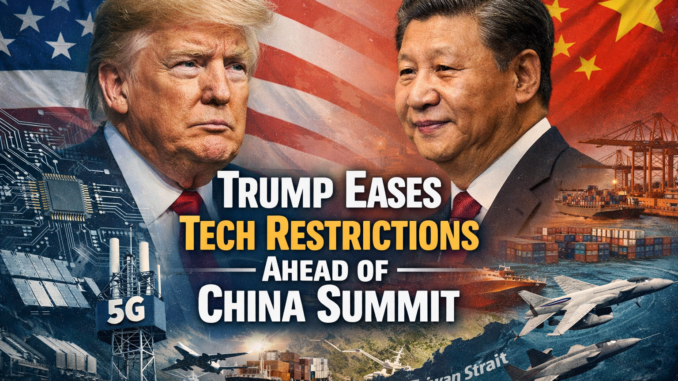

The long-awaited, high stakes summit between U.S. President Donald Trump and President
Xi Jingping of China is still scheduled to take place May 14-15, in Beijing, according to the
White House, after having been rescheduled from April due to issues with the ongoing
Middle East conflict. The proclaimed monumental summit aims to stabilize U.S.-China
relations, focusing on trade disputes, tech controls and ongoing military tensions in the
Taiwan Strait.
Prior to the originally planned April meeting, Trump shelved numerous tech restrictions on
China, while Chinese sources announced that the two sides aimed to extend their trade
truce for a year during Trump’s visit, in return for new Chinese commitments, with one
source suggesting automobile and energy agreements.
The measures Trump has reportedly shelved include restrictions on Chinese equipment
used at U.S. data centers, a ban on China Telecom’s U.S. operations and a ban on U.S.
sales of Chinese electric trucks and buses.
While the loosening of restraints will help deter trade escalations with China ahead of the
summit, those potential escalations remain high in post-summit relations, despite plans
for a year-long tariff truce. There are still plenty of U.S. tech restrictions outside of Trump’s
purview that could spur new Chinese retaliation, such as recent engagements in Latin
America that could threaten Chinese resource and investment stakes, and the expanding
arms support for Taiwan.
However, the conflict in the Gulf, and the strain on oil supply with the blockade reportedly
being instituted in the Strait of Hormuz, further impacts China by creating severe energy
supply vulnerabilities, shipping disruptions and rising costs. China is the world’s largest
importer of oil via this route.
For the time being, China is better able to withstand this crisis than most others, thanks to
their massive energy stockpiles (roughly 1.4 billion barrels) and diversified supplies,
including pipelines.
China has openly condemned the U.S. blockade as “dangerous and irresponsible” and has
outwardly complained about the effect on their energy and trade deals with Iran. At the
same time, the conflict has accelerated China’s expansion into green energy sectors, with
demand high for its solar, wind and EV products as global markets reduce fossil fuel
reliance.
With the resulting talks between the U.S. and Iranian officials last weekend yielding no deal
on matters pertaining to the Strait of Hormuz and otherwise, Trump posted on social media
that the U.S. would impose a blockade of the Strait.
But in a narrower order issued later, the U.S. military said American forces would blockade
only “maritime traffic entering and exiting Iranian ports”. The order said U.S. forces would
“not impede” vessels traveling to or from non-Iranian ports.
Beijing issued a statement urging all parties to remain calm and restrained, stressing that
the war is the “root cause” for the disruption of navigation.
Last year, the Gulf states supplied 42% of China’s crude oil imports, according to customs
data. Separately, about 12% of Chinese crude oil imports came from Iran.
If the U.S. can deliver on its promise of allowing non-Iranian ships, including Chinese ships,
to transit the Strait, it could flip the narrative and frame itself as a guarantor of free
navigation.
Iran maintained on Monday that the Strait would remain closed to vessels “affiliated with
the enemy”.
There are reports that China has been able to sustain their Iranian oil trade through a “gray
network” of shadow tankers, ship to ship transfers and yuan-based payments specifically
designed to circumvent U.S. sanctions, according to Jesse Marks, founder of Rihla
Research and Advisory, a Washington-based Middle East consultancy.
Beijing has repeatedly denied such allegations and claims all bilateral trades are
conducted within the confines of international law.
Furthermore, some see the blockade as a Trump negotiating tactic just weeks away from
the summit. “He wants to walk into the summit with a chokehold on something China
needs,” said Marks, “so he can trade relief concessions on rare earths, trade terms or
political cooperation on Iran.”
Beijing has not yet officially confirmed the specific dates for the rescheduled visit.
