
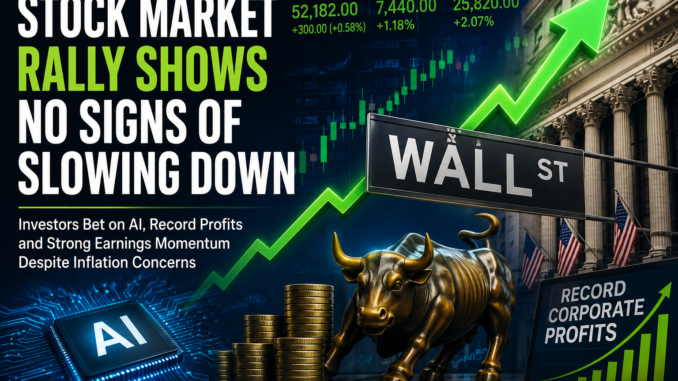

The seemingly never-ending stock market rally shows no signs of slowing down, even after
last week’s tech sell-off and the latest inflation report showing the core number climbing to
2.9%, the highest level for that number since September 2025. As little as two years ago, it
was all but assumed the stock market would go through an extended period of pain,
especially if inflation began creeping up to the post-pandemic level.
Yet, on Monday, the Dow jumped 300 points, buoyed by Alphabet making its debut to the
index, rounding out a broader rally to close at an all-time high of 52,182. The S&P 500 rose
1.18% to close at 7,440, while the Nasdaq increased 2.07%, and a 25,820 close.
Goldman Sachs raised its target for the S&P 500, projecting the broad-based index could
reach 8,000 by the end of the year, a 7.5 percent increase from its current level.
While the shortened week generally inspires bigger than expected moves, and the U.S.-Iran
agreement to pause hostilities and allow vessels to traverse the Strait of Hormuz freely–
following a weekend of military exchanges that threatened to derail negotiations–certainly
helps the positive feelings and encourage liquidity, it’s still curious that the market
continues by-in-large unabated from the cost and price pressures continually experienced
by everyday Americans.
With increasing inflation, everyday cost of living spikes and the inability to save hampering
most Americans (as witnessed by credit card balances that are 90 days past due currently
sitting at 13.1%, the highest in 15 years, and indicative of people using credit cards for
essential purchases), Wall Street remains very upbeat, despite the gloominess pervading
Main Street.
“I’ve been doing this for 25 years, and I’ve never seen anything like this,” said LPL chief
financial equity strategist Jeff Buchbinder. “It’s really amazing how big these earnings
numbers are.”
And the answer may lie in what is becoming the ubiquitous response for most questions
concerning business, investment and economics: investors are focused on artificial
intelligence’s potential to boost productivity, and on record corporate profits that seem to
be growing more robust through Quarter 2.
Tech companies’ earnings grew by 50% on average in the first three months of this year, far
stronger than the 10 percent growth they typically see during this cycle. Excluding tech
companies, U.S. corporations saw their earnings boosted by 20% in the first quarter or
double the typical rate. Businesses have benefited from the lower tax rates and other
breaks enacted last year under the so-called “Big Beautiful Tax and Spending Bill”.
Typically, investors analyze price-to-earnings (P/E) ratio—a stock or index’s price divided by
its expected future per-share earnings—to determine whether the shares are overvalued or
undervalued. In the case of the S&P, the index’s P/E ratio has fallen as earnings have
increased faster than the market.
That dynamic has made stocks look more affordable and attractive to investors.
Toss into that the optimism generated by AI and its promise to boost corporate productivity,
and investors are heavily betting that AI will transform the global economy. Some warn of a
potential ‘bubble-burst’ akin to the dot-com boom of the late 90s. But unlike that era, the
companies leading the AI boom are already giants, and even the newer entrants are
showing strong revenue growth.
Investors are also looking past the lingering U.S.-Iran conflict in a way that is contradictory
to typical market behavior. Even as per barrel cost of Brent crude soared, investors
continued to bet that the conflict would resolve itself and ships would begin to travel the
Strait of Hormuz more freely, easing inflationary pressures and global oil prices.
That view may be dangerously “rose-tinted” as there has been no long term,
comprehensive settlement reached, but rather a “14-point memorandum of
understanding” that is aimed to facilitate further diplomatic negotiations.
Broadly speaking, the same factors that have spurred market growth could present the
risks of a potential turnaround. Should the war drag on indefinitely or should AI companies
fail to deliver on investors’ lofty expectations, those Bearish sentiments on Main Street
could make their way into the markets.
One red flag that investors are nervously watching is whether the Federal Reserve will issue
interest rate cuts anytime soon. At their last meeting (June 17) the Fed decided to keep the
benchmark lending rate the same at 3.50%-3.75%, and the market reflected that fear of no
rate cuts with a recent rise in Treasury yields. Higher bond yields and sticky inflation could
cap market growth if these conditions persist.
The direction of the market’s travel could hinge on whether rates stabilize and whether
incoming economic data confirm that growth can hold without reigniting inflation.
