

The ability to design strategies that anticipate disruption determines whether business leaders and owners fail, survive, or thrive through tumultuous times.
As a leader, you need an enhanced business strategy to bring your organization together and navigate today’s evolving ecosystems. This involves improving efficiency in your operations to counter climate disasters. It means strengthening your financial margins to cope with disruptive political actions. It compels you to address changed cultures if you hope to retain and stabilize your workforce as social complexity increases. And it challenges you to devise processes for delighting your customers while wrestling with constantly changing technology.
Formulating a living strategy that strengthens the practices of your company — updated and revised regularly — will lead to a brighter future as you’re confronted by increasingly disruptive forces. It will enable you to chart possibilities, innovate how your company performs, and thrive in an unpredictable economy.
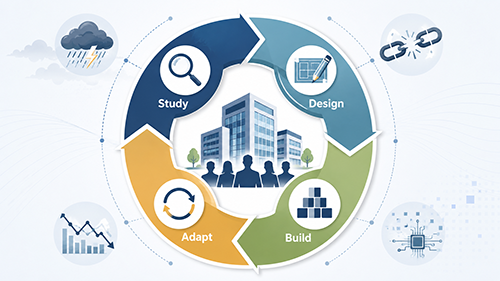
The strategy involves the four components: study, design, build, and adapt.
- Study.Achieving resilience involves disciplined planning. It begins with studying your ecosystem to determine the status of competitors, suppliers, and internal culture.
To cite an example, McDonald’s in the DC region gathered information on competitors by sending teams of managers and crew members to drive through competitors’ parking lots at noon. They counted cars to determine market share; they ordered drive-through meals and timed order fulfillment; and they sampled the food and evaluated the accuracy, taste, and temperature of each meal. They then evaluated their own restaurants using the same criteria (number of cars, speed of service, and food quality). They used the comparative data to design and build a strategy to gain more market share.
Additionally, it’s important to take stock of your organization’s internal culture and evaluate the integrity of how your company board and leadership team balances the pursuit of wealth with adherence to principles. Step back to assess aspects such as whether your organization clearly states its principles and describes how each is practiced. Note whether it transparently shares its financial status internally, and how well it works to enhance the well-being of employees. Improving culture through leadership integrity contributes to organizational resilience.
- Design. This component involves processing information obtained in the study stage through the lens of past, present, and future events. It’s important to include stakeholders, such as your employees, management, suppliers, investors and customers, in designing solutions that resolve problems restraining your company from becoming resilient.
For instance, if your company is experiencing high turnover as well as recruitment and retainment issues, designing a more effective and focused strategy to recruit and onboard new team members will reduce both forced and unexpected terminations. And, importantly, it will lead to major cost reduction as you retain your talent.
- Build.After devoting large amounts of time, energy, and money toward designing innovative strategies, it’s important that you don’t allow them to gather dust on a shelf. The build component is the stage for implementing tactics and achieving goals. It involves creating action plans for implementing your strategic design.
Devise your action plans so that they:
-State the strategy, or the “what”
-List the names of participants assigned to deliver results, the “who”
-Record the timing for delivery, the “when”
-Provide space to record the status of the strategy
Form teams that extend beyond specific departments. For instance, a customer satisfaction team might consist of staff from operations, marketing, sales, and accounting.
The team assigned to each strategy must then establish regular meetings to accomplish the work and update its status. As a leader, plan for regular updates through forums designed to keep everyone engaged.
- Adapt.It’s not enough to anticipate and prepare for disruptions. The key to resilience and a brighter future rests on adapting your plans to changing conditions.
For example, when COVID struck and disrupted its businesses operations of an insurance agency, The Pressley Group, leadership coordinated a virtual retreat in which everyone helped design a plan for moving forward. They worked to create a more efficient operation that included developing a customer newsletter, establishing daily and weekly communications, and improving their lead generation tools. Their adaptations enabled company growth to continue — it improved sales from 50 to 80 through the first month of the shutdown.
Failure to assess, plan, execute on the plan, and revise plans to changed circumstances is a prescription for failure in today’s turbulent times. Survival and growth come from charting a system that enables your company to continually innovate and succeed no matter what eruptions may occur.
