
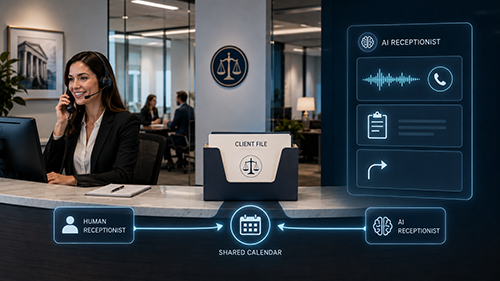

Law firms lose clients before an attorney ever says hello. A prospective caller hits voicemail at 6 PM, waits on hold during a lunch rush, or gets routed to the wrong person entirely. By the time someone follows up, they’ve already signed with another firm. The front desk isn’t just an administrative function; it’s where revenue either lands or walks out the door.
That reality is what makes the rise of AI receptionist technology so consequential. These systems don’t take breaks, don’t call in sick, and don’t fumble a high-value intake at 11 PM on a Saturday. For a profession where first contact shapes client trust, that kind of reliability matters.
But can AI actually replace a legal receptionist? The answer is nuanced, and it starts with understanding what these tools can genuinely do and where they still fall short.
What AI Receptionist Technology Actually Does
At its core, AI receptionist technology is a stack of integrated capabilities working in real time. It’s not a single product but an ecosystem of tools layered together.
Natural Language Processing and Voice AI
Modern AI receptionists rely on large language models and speech recognition to have fluid, context-aware conversations. These systems can understand caller intent, respond to multi-part questions, and navigate awkward pauses or accented speech without stumbling. The leap from the clunky IVR systems of the early 2000s to today’s conversational AI is staggering.
Scheduling and CRM Integration
Once a caller is qualified, the AI can book consultations directly into an attorney’s calendar, sync with case management platforms, and push structured intake notes into a CRM. No human in the loop, no dropped ball. According to the Thomson Reuters 2024 Future of Professionals Report, AI tools are projected to free up 12 hours per week per professional within five years, a figure that becomes even more significant when applied to administrative overhead in lean legal teams.
Where AI Handles the Heavy Lifting
The legal front desk is, at its core, a triage function. And triage is something AI handles exceptionally well when structured properly.
Here’s what the technology manages with remarkable consistency:
- 24/7 call answering with no hold times, sick days, or turnover costs
- Conflict-of-interest screening based on pre-set intake rules
- Practice area qualification ─ routing personal injury queries away from estate planning attorneys
- Lead capture during nights, weekends, and holidays, when most conversion opportunities are lost
- Multilingual support, enabling firms to serve broader client demographics without hiring bilingual staff
This is exactly where purpose-built law firm intake software earns its keep, not just answering calls but systematically converting inquiries into structured, attorney-ready intake records.
The Gaps AI Still Can’t Close
Here’s where the conversation gets more honest. AI is precise. Legal intake is frequently ambiguous.
Emotional Intelligence and Crisis Handling
A caller describing a domestic violence situation or a pending criminal charge is rarely presenting a clean, logical narrative. They’re scared, sometimes incoherent, and they need to feel heard. AI can detect emotional distress and escalate to a human agent, but it cannot replicate the judgment a seasoned receptionist applies in real time. That soft skill, the ability to de-escalate and build trust in the first 90 seconds of a call, remains distinctly human.
Ethical and Confidentiality Obligations
Legal intake isn’t just a customer service function; it carries regulatory weight. The American Bar Association’s Formal Opinion 512, issued in 2024, explicitly flags that AI tools handling client data must comply with Model Rule 1.6 on confidentiality. Firms deploying AI receptionists need to ensure that data flows, storage practices, and vendor agreements meet those obligations. That’s not a reason to avoid the technology. It’s a reason to implement it carefully.
Comparing AI to Human Receptionists: The Real Scorecard
The comparison isn’t binary. It’s about task fit.
- Speed and availability: AI wins, unambiguously
- Cost at scale: AI wins significantly, for high-volume firms
- Complex emotional situations: Human wins
- Consistency and compliance: AI wins when properly configured
- Warm client relationships over time: Human wins
- Data capture accuracy: AI wins, especially when integrated with intake workflows
The Wolters Kluwer 2024 Future Ready Lawyer Survey found that firms that are slow to adopt technology risk losing both clients and top talent to those that move faster.
The Verdict: Replacement or Reinforcement?
For high-volume practices with predictable intake categories (personal injury, immigration, family law), AI can genuinely handle the receptionist function during off-hours and overflow periods. For complex litigation boutiques or highly relationship-driven practices, a hybrid model makes more sense: AI handles the triage, a human handles the nuance.
The most successful firms aren’t asking whether AI can replace their receptionist. They’re asking how AI can make their receptionist or their lean team dramatically more effective. That reframe, not the binary replacement question, is where the real competitive advantage lives today.
The Bottom Line
AI won’t replace every legal receptionist today. But it is already replacing the version of the role that sits idle after 5 PM, drops calls during lunch, and loses qualified leads to voicemail. For law firms serious about growth, that’s more than enough reason to pay attention.
About the Author
Vitaliy Kononov is CTO at Atty, an AI-powered platform that helps law firms answer client calls, capture key details, and schedule consultations automatically. With 15+ years of experience in software engineering and technology leadership, he has built and scaled global teams and developed award-winning digital products for enterprise clients.
