
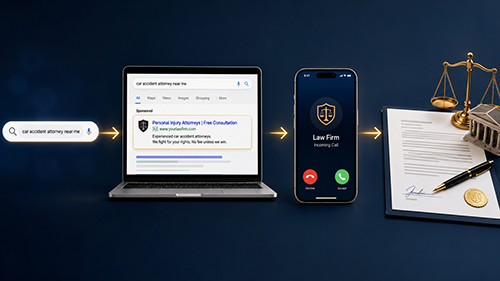

For decades, law firms marketed the way their founders did — Yellow Pages, billboards, referral lunches. That playbook is dead. The firms growing fastest in 2026 are running paid search campaigns with the same rigor a SaaS company applies to customer acquisition. The rest are wondering why their website traffic isn’t converting.
I run a Google Ads agency that works exclusively with law firms. Here’s what separates the practices adding 30–40 qualified leads per month from those spinning their wheels on digital spend with nothing to show for it.
Stop buying traffic. Start buying intent.
Most law firm marketing dollars chase impressions — brand awareness, social reach, organic rankings. These matter, but they compound slowly. The channel that converts fastest for law firms is paid search, because it puts your message in front of someone actively typing “divorce lawyer near me” or “car accident attorney free consultation” at exactly that moment.
The mistake firms make is treating Google Ads like a billboard — set it, forget it, hope for calls. High-performing law firm campaigns are built around intent signals: which keyword phrases indicate someone ready to hire versus someone still researching? Bidding on “what is a DUI” burns budget. Bidding on “DUI lawyer [city] free consultation” gets clients.
Your intake is the campaign.
Even a technically perfect ad campaign falls apart at the phone. We’ve seen firms spending $10,000 per month on ads lose half their leads because no one answered after 5 PM, or because the intake call felt like a deposition rather than a conversation.
The math is simple: if a qualified lead costs you $150 in ad spend and your intake team converts 20% of calls to signed clients, each client costs $750 in marketing. Push that conversion rate to 40% and your effective cost per client drops to $375 — without changing the ad budget. Marketing strategy and intake strategy are the same strategy.
Attribution tells you where to double down.
The firms with the strongest marketing ROI have one thing in common: they know which campaigns are producing signed clients, not just calls. Call tracking, CRM integration, and honest attribution — including offline conversions — close the loop between ad spend and revenue.
This matters because digital marketing for law firms isn’t cheap. Competitive practice areas like personal injury, mass tort, or immigration can run $50–$200 per click. Without knowing which keywords actually produce cases (not just calls, but signed retainers), you’re optimizing for the wrong metric.
The competitive window is narrowing.
Four years ago, running a technically competent Google Ads campaign for a law firm was enough to win. Today, every mid-size firm has an agency. The edge now goes to firms that combine strong paid search fundamentals with a superior landing page experience, a credible review profile, and a website that passes Google’s growing quality bar for EEAT — expertise, experience, authoritativeness, and trust.
Answer Engine Optimization is the next frontier. As more potential clients search through AI tools — “which type of lawyer do I need for a landlord dispute?” — firms that have built structured, authoritative content will get cited. This isn’t theoretical; it’s already happening in high-volume practice areas.
The bottom line for business leaders
If you lead or own a law firm, the question isn’t whether to invest in digital marketing. It’s whether you’re measuring it like a business investment or treating it like an expense line. The practices adding $500K–$2M in revenue per year through paid search aren’t spending more than their competitors — they’re measuring better, optimizing faster, and connecting marketing directly to signed cases.
The firms that figure this out in the next 18 months will have a structural cost-of-client-acquisition advantage that compounds. The ones that don’t will keep asking why their website isn’t working.
