
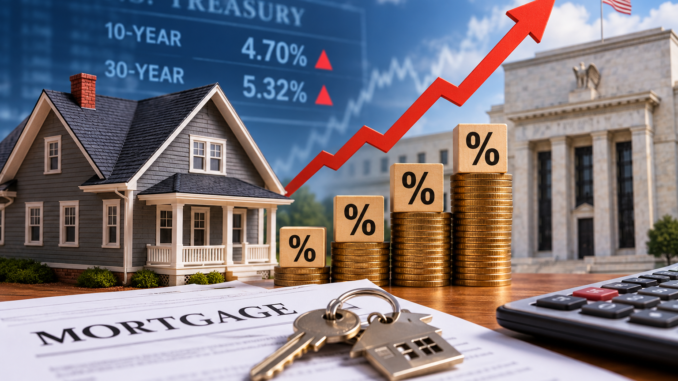

The housing market took another downward turn last week, as the fixed rate for a 30-year
mortgage rose to 7.18%, with some larger lenders charging as much as 7.37%. Due to
increasing inflationary pressures, yields on longer-term bonds have reached their highest in
decades, ultimately elevating long-term borrowing costs.
During the global bond sell off last month, the U.S. 30-year Treasury bond hit 5.32%, a 19-
year high, while the 10-year yield, a key benchmark for fixed mortgage rates and other
longer-term loans hit 4.7%, compared to the below 4% rate prior to the start of the Iran
conflict.
“The higher bond yields on longer dated securities, like the 30-year Treasury, clearly
indicate some discomfort over persistently high inflation in the future,” said Lawrence Yun,
chief economist for the National Association of Realtors.
The current inflation rate of 3.4%, as measured by the consumer price index, is not only far
above the 2% target rate preferred by the Federal Reserve when setting benchmark lending
rates, but a full point above the 2.4% rate in January 2026. Home mortgage rates had also
just dipped below 6% in January, leading some to speculate the home buying market could
be on a rebound this year.
Instead, the spring and summer homebuying season has been worse than expected, with
home sales in August reaching their lowest in the last 14 months.
Still, overall, the economy has shown signs of resiliency—unemployment remains low,
retail spending is solid and the stock market remains high, mainly due to the massive tech
investment.
With that, the Fed has raised interest rates to control inflation and may continue to do so,
leaving the long-term yields in the bond market vulnerable.
“Longer-term bond investors may need more evidence that the post-pandemic inflation
cycle is truly behind us,” said Jeff DerGurahian, LoanDepot’s chief investment officer and
head economist. “And that the economy is returning to a slower-growth, slower-inflation
environment before 10- and 30-year Treasury yields move meaningfully lower.”
Since 15 and 30-year fixed-rate mortgages typically follow the lead of Treasury rates, higher
yields have already been pushing up mortgage rates.
“The impact on mortgage rates is directly related to higher bond yields,” Yun said.
“Independent of the Federal Reserve policy, higher inflation and higher overall long-term
borrowing costs will mean higher mortgage rates.”
As for dealing with the higher rates, some experts suggest shorter term loans.
“Some may want to consider shorter-term mortgage rates, like seven-year [adjustable-rate
mortgages], which lock in fixed mortgage payments for the first seven years of the loan
before readjusting,” Yun said. “These shorter duration loans are ideal for those who are
more certain they will move to another home within that seven-year time frame.”
As for other consumer loans, auto loans, credit cards and student loans are also tied to
bond yields, meaning those monthly payments could increase as well, as long term rates
are typically a pass-through to some consumer rates.
Renewed worries about the trajectory of Fed interest rate policy could weigh on variable
credit card rates, which are closely tied to the prime rate and influenced by inflation
expectations.
Auto loans are also susceptible to broader lending factors. Sustained pressure on Treasury
yields also push up borrowing costs across the lending spectrum.
“With average new APRs already stuck around 7% and used vehicles at 10.6%, consumers
are already paying heightened interest,” said Jessica Caldwell, head of insights at
Edmunds. “If higher bond yields keep interest rates elevated, auto lenders will have little
choice but to maintain or even bump up APRs, further stretching consumer budgets.”
Federal student loan rates, however, are fixed for the life of the loan, but rates for new
borrowers rose in the year ahead based on the last 10-year Treasury note auction in May.
While the booming AI and tech sector are pretty much immune to higher interest rates, the
weaker sectors of the economy, including home and auto purchases, bear the brunt of rate
increases during these trends.

Be the first to comment