
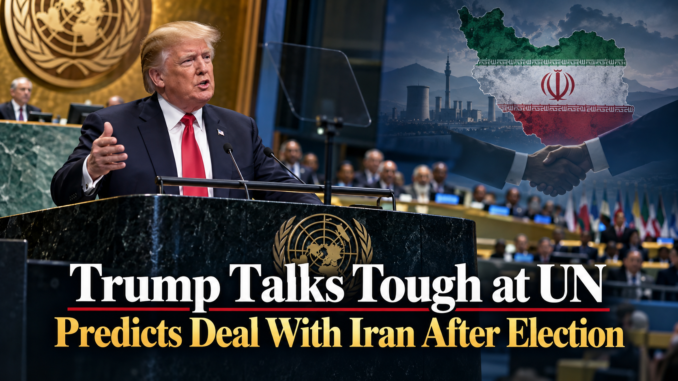

Nearly 130 world leaders gathered for the United Nations General Assembly in New York
this week to discuss issues ranging from the wars in Ukraine and Iran to the environment to
the rapid development of artificial intelligence.
On Tuesday, in his address to the General Assembly, President Donald Trump made his
case for the war with Iran, and the broad proclamation that Iran has a decision to make.
“Will a deal be made with Iran that lets them rebuild,” said Trump. “Or do I annihilate the
Islamic Republic and do it quickly?”
Trump predicted the U.S. would strike a deal with Iran shortly after the upcoming mid-term
elections and called on other nations to join the U.S. in isolating Iran economically, in turn
forcing them to the negotiating table.
As for Iran’s response the following day, President Masoud Pezeshkian pushed back against
Trump’s claims, denying that Iran is seeking a nuclear weapon, but rather development of a
nuclear program as a source for energy.
He also expressed a willingness to negotiate. “It must be understood by Mr. Trump and
those who seek to bully us that we are ready for dialogue and diplomacy and negotiations
without accepting the language of force,” said Pezeshkian.
Reportedly, the U.S. delegation walked out of the assembly hall during Pezeshkian’s
remarks.
In his 37-minute address, Trump laid out his vision of U.S. dominance in the Western
Hemisphere as essential in preventing crises from taking root. He also spoke of U.S.
munitions stockpiles, his plans to establish a larger military presence in Greenland and
vowing the communist government of Cuba “will fall”, to which members of the Cuban
delegation stood and left the assembly.
Later that day, Trump signed a deal with Denmark permitting the U.S. to establish a larger
military presence in Greenland, potentially resolving the growing standoff with the mineral
rich island.
The deal will allow the U.S. to begin building a pair of large military bases immediately,
upon which Trump declared “No U.S. adversary will ever be permitted to establish a
military presence in Greenland anymore, or make sensitive investments there without our
express written approval.”
Trump also met with Ukrainian leader Volodymyr Zelensky to discuss efforts toward ending
the four-year old war with Russia, including a potential bilateral ceasefire on energy related
targets.
In Zelensky’s comments to the media, he reiterated that he was ready to meet Russian
President Vladimir Putin at a trilateral meeting with Trump, adding that he hoped the U.S.
would find a way to bring Moscow back to the negotiating table after talks unraveled earlier
this year.
Zelensky, however, did say he saw no indication that Putin was ready to talk. “I’m ready for
a trilateral meeting. It means that I am agreed to end the war,” said Zelensky.
Prior to the meeting, Trump told reporters of his concern regarding Ukraine’s attacks on
Russian oil refineries.
“It’s a serious hit on the Russians,” said Trump. “It’s also a serious hit on the price of
diesel.”
Trump stated that Russia and Ukraine had agreed to not strike any energy targets, but any
semblance of that détente vanished when Russia hit petrol stations in Kyiv and Ukraine
bombed a Russian oil refinery.
Diesel prices have become a major issue for the U.S. and President Trump, as the fuel,
central to business transport, hit a record high in recent weeks, resulting in Trump facing
record low approval ratings and pressure from his own party members to resolve the Middle
East conflict and restore more stability to fuel and energy prices.
As for the AI boom, Trump reiterated that recent warnings sounded by industry insiders, as
well as the heads of the largest AI companies, are a “hoax” and our forward pursuit of the
technology should not be slowed or abandoned.
“I’m not going to stifle the growth of something that will be bigger than the Industrial
Revolution,” said Trump. He also cited that the U.S. government should use the term “super
intelligence” instead of artificial intelligence and that U.S. law enforcement agencies would
rein in the sector if needed.
U.S. lawmakers from both parties have introduced legislation to regulate AI.
While industry leaders concur that the U.S. outpaces China in model capability, the gap
between the U.S. and China could shrink if development proceeds more slowly in the U.S.,
while China continues unabated.

Be the first to comment