
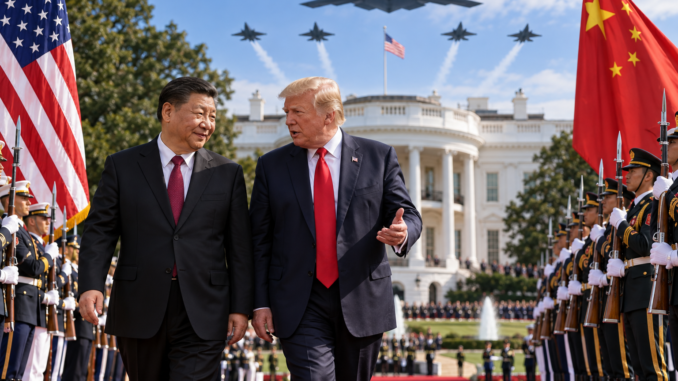

For the second time this year, President Donald Trump sat down with Chinese President Xi
Jinping for a White House gathering high on pageantry but low on substance. The two heads
of state met at the White House on Thursday morning, which began with a state arrival
ceremony consisting of military honors, a full review of troops, the playing of the Chinese
and American national anthems and a flyover by a B-2 stealth bomber in formation with
four fighter jets.
Once again, Trump went out of his way to compliment Xi, touting their “truly great
friendship”, and noting that the two rivals have made great strides on trade since his visit to
China in May.
This was Xi’s first visit to Washington in more than a decade.
Trump and his administration officials held bilateral talks with the Chinese delegation from
late morning into early afternoon, lasting for several hours. Trump and Xi also had
discussions in the Oval Office privately, whereafter the two walked the South Lawn of the
White House viewing Marine One and the helipad where it is docked.
The President also escorted Xi through the White House ballroom, still under construction,
and the Presidential Walk of Fame outside the West Wing, which features headshots of
past Presidents.
Trump apparently installed a photo of an autopen in the place of former President Biden’s
photo on the Walk of Fame, as Trump frequently criticized Biden for relying on the autopen.
Trump and Xi were seen laughing at the portrait, according to social media posts.
Trump’s reported agenda in the discussions included exploring a wide-ranging deal on
possible tariff reductions on non-strategic goods, as well as a discussion of rare earth
exports and possible export control, and Trump was expected to press Xi to do more to
curb fentanyl precursor chemical exports.
Reportedly, Trump and Xi signed a trade truce that was due to expire in November. The
agreement covers a subset of goods the two can trade on more favorable terms, marking
some positive progress in negotiations between the world’s two largest economies.
Details are expected to be released on Monday, but reports indicate the agreement
includes U.S. agricultural products and medical devices and Chinese consumer goods
considered nonsensitive.
No official statements on the discussions were made to the press, short of Trump’s
description of the talks being “great”, and no questions from the media were taken by
Trump or White House officials.
Outside of the White House, groups of protestors gathered, loudly chanting “Free Hong
Kong”, “Xi Jinping, you’re not welcome” and “freedom for political prisoners” in reference to
Chinese oppression, throughout the day and into the evening, at times drowning out the
state dinner at the White House, according to published reports from Fox News Digital.
The formal state dinner was attended by multiple giants in the tech and finance world,
including Nvidia CEO Jensen Huang, OpenAI CEO Sam Altman, SpaceX founder Elon Musk
and many others. The presence of the AI giants underscores the arms race unfolding
between the two superpowers, as leaders in the AI community have recently sounded
warning bells that the technology may be evolving at a rate faster than human capability
can manage, while the President has publicly stated such warnings are a hoax, and the
price of slowing down discovery is too great.
Still, there was no agreement on addressing the risks of rapidly developing AI, ending the
war with Iran or any concrete stops toward solving other problems, including the growing
challenge of transporting oil and fuel.
Although a vanilla state visit, featuring much pomp and circumstance and little in the way
of concrete agreements, may have been somewhat intentional.
“Ahead of the midterms, President Trump’s interest is to keep things calm,” said Scott
Kennedy, a Center for Strategic and International Studies senior advisor who studies the
Chinese economy. “We have interest rates getting to record highs, and he doesn’t want to
make markets even more skittish.”

Be the first to comment