
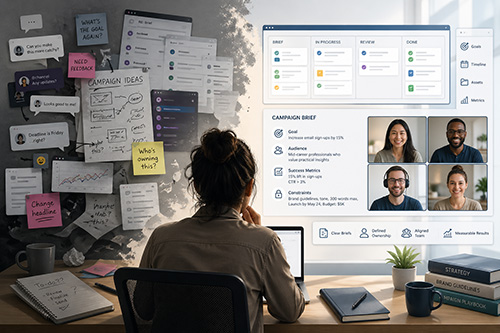

There is a moment every remote marketing manager knows well: you send a campaign brief on Monday, check in on Thursday, and somehow the team interpreted “bold and minimal” as “neon and chaotic.” No one is at fault. The brief was there. The talent was there. What was missing was the system.
I learned this the hard way when I transitioned from leading an in-house team to managing a distributed crew of writers, designers, and strategists spread across four time zones. It was humbling. It was also the best education in project management I’ve ever received. Here’s what I would tell my past self, and what I hope saves you a few painful detours.
Build a Culture Before You Build a Workflow
Most managers jump straight to tools and timelines. I get it, structure feels productive. But remote marketing teams fail at the culture layer long before they fail at the process layer.
When your team can’t read the room, they rely on trust to fill in the gaps. Trust isn’t built through a Slack announcement. It’s earned through consistent check-ins, transparent goal-sharing, and leaders who model what they expect.
Start With Team Rituals
Establish low-friction, high-value rituals. A weekly 30-minute video standup where everyone shares one win, one blocker, and one priority for the week works wonders. Not because it’s revolutionary, but because it’s reliable. Consistency creates psychological safety, and psychological safety is what gets people to raise red flags early before that campaign launches with the wrong CTA.
Normalize Asynchronous Communication
Not everything needs a meeting. Defaulting to meetings in remote settings is one of the costliest habits I’ve seen. Train your team to communicate in writing: Loom videos, recorded feedback, annotated briefs. This creates a searchable paper trail and respects the autonomy remote workers genuinely value.
Master the Art of the Brief
A bad brief is the silent killer of remote marketing projects. In an office, you clarify with a quick walk to someone’s desk. Remotely, ambiguity compounds: hours of work go in the wrong direction before anyone realizes.
A great marketing brief should answer these questions before a single pixel is moved or a word is written:
- What’s the goal? Not “raise brand awareness”, that’s too vague. Say “increase email signups by 15% through this landing page campaign.”
- Who’s the audience? Include psychographic detail, not just demographics.
- What does success look like? Define KPIs upfront.
- What are the constraints? Brand guidelines, tone, word count, deadline, and budget.
When briefs are airtight, feedback rounds shrink dramatically, reclaiming hours every week across your team.
Use the Right Tools and Actually Use Them
Here’s something no one tells you: the best project management tool is the one your team will actually open. I’ve watched teams pay for enterprise platforms that gathered digital dust while everyone coordinated over email threads.
For remote marketing teams, I recommend a simple stack: a project management tool (Asana, ClickUp, or Notion work well), a shared asset library, and a communication platform with clear channel etiquette. What matters more than the tools themselves is adoption. Run onboarding sessions. Create usage norms. Review compliance in retros.
Don’t Overlook Your Content Optimization Stack
If your team produces written content (blog posts, landing pages, ad copy), content quality and discoverability go hand in hand. Integrating an on-page SEO tool into your workflow ensures that writers aren’t just producing good prose but content that actually ranks. The best teams I’ve worked with treat their on page SEO tool as a collaborative layer, not an afterthought.
Editors and strategists review content recommendations together before publishing. Choosing the right SEO tool that integrates with your CMS can shave hours off your optimization process each week.
Define Ownership Without Micromanaging
One of the trickiest balancing acts in remote management is knowing when to step in and when to step back. Micromanagement kills morale faster in remote settings because it signals distrust loudly. Every check-in becomes a surveillance event rather than a support gesture.
The antidote is radical clarity around ownership. Use a simple RACI framework:
- Responsible ─ who does the work
- Accountable ─ who owns the outcome
- Consulted ─ who gives input
- Informed ─ who needs updates
When everyone knows their lane, there’s less friction and far fewer “I thought you were handling that” moments.
Measure What Moves the Needle
Remote teams can easily slip into looking busy mode: high activity, low impact. Build a culture of outcome-focused performance reviews. Set monthly OKRs at the team level, cascade them into individual deliverables, and review them without judgment in retrospectives.
The retrospective, done well, is the single most powerful tool in a remote manager’s arsenal. It surfaces what’s broken before it becomes catastrophic and gives your team a voice in shaping how they work.
Managing a remote marketing team is less about control and more about architecture, designing conditions where talented people do their best work, even thousands of miles apart. Get the foundations right, and the creativity takes care of itself.
