
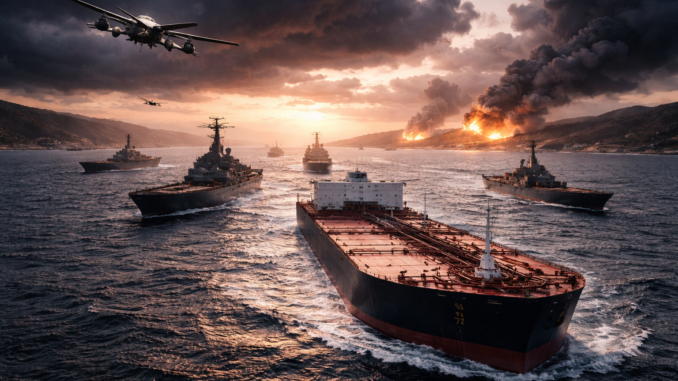

As traffic through the Strait of Hormuz has dropped to a trickle compared with travel prior to the start of the U.S./Israel-Iran conflict, President Donald Trump has continued not only to offer the security of the U.S. Navy to escort vessels safely through the region, but has also stepped up his efforts to offer insurance to protect maritime travel through the combative area.
Since the start of the conflict, major insurers have issued notices of cancellations with respect to war insurance coverage for vessels traveling through the Persian Gulf, Gulf of Oman and the Strait of Hormuz.
As of March 1, vessels passing through the Strait of Hormuz have been as few as 1 to 3 per day, compared with prior traffic, which had as many as 60 or more tankers per day traversing the strait, most carrying oil, with others carrying either liquefied gas or chemicals.
While Trump’s assurances to provide military support and insurance helped ease the energy market initially, prices have once again begun to trend sharply upward, reaching as high as $119 per barrel for Brent crude before settling back down to $98 after Israeli Prime Minister Benjamin Netanyahu’s comments that the Iran war “will be ending a lot faster than people think.”
Netanyahu claimed the U.S. and Israel were well on their way to achieving their goals, which included weakening Iran’s nuclear and missile programs and its support for armed proxies, to enable the Iranian people to overthrow the theocracy.
This followed Israel’s retaliatory strike on an Iranian gas field, to which Iran’s response was to hit targets in Qatar, sending the energy market into a fervor.
Trump issued a scolding on social media and requested that Israel carry out no such attacks moving forward.
The market settled down for the day, but things remain volatile and uncertain, especially with the Hormuz passage at a standstill.
Shortly after the conflict began, Trump ordered the United States International Development Finance Corporation (DFC) to make insurance available to protect affected maritime travel.
The DFC describes itself as the “international investment arm of the U.S. government” and provides “political risk insurance and guarantees” for maritime travel through the Gulf.
The DFC did announce a plan to provide insurance covering losses of up to $20 billion “to deploy Maritime Reinsurance, including war risk in the Gulf region,” noting that businesses and financial institutions seeking to access DFC insurance should contact the DFC directly.
One consideration, however, is budgetary constraints, as all DFC-backed projects must be evaluated for “economic and financial soundness and development objectives,” and the DFC must notify congressional committees regarding any financial commitment exceeding $100 billion.
More significantly, the DFC must operate within its congressionally approved maximum contingent liability, currently standing at $250 billion through 2031.
Industry commentators have observed that such fiscal constraints may affect the scale of coverage the DFC is able to provide.
Apart from providing insurance, the president has maintained that the force of the U.S. military can be used to provide safe passage through the Strait to American and allied vessels.
Iran has announced it is keeping the strait closed specifically to ships from the U.S., Israel and their allies.
Trump went so far on Saturday as to issue an ultimatum to Iran to keep the Strait open to all traffic or face military strikes on power plants and beyond within 48 hours.
The U.S. has argued that Iran’s Revolutionary Guard controls much of the country’s infrastructure and uses it to power its war effort.
Under international law, power plants that benefit civilians can only be targeted if the military advantage outweighs the suffering caused to them.
Iranian Parliament Speaker Mohammad Bagher Qalibaf posted on social media that if the U.S. attacks Iranian power plants and infrastructure, then vital infrastructure across the region—including energy and desalination plants critical for drinking water in Gulf nations—would be targeted and “irreversibly destroyed.”
On Monday, Trump said he was lifting his ultimatum in light of “good and productive” peace talks with Tehran.
Iranian state media denied there had been any talks. However, later in the day, the Iranian Foreign Ministry publicly stated that it had “received points from the U.S. through mediators and they were being reviewed.”
In addition to infrastructure threats, Iran has also threatened to arm the Strait of Hormuz with sea mines. Current American intelligence assessments show that there are at least a dozen Iranian mines in the Strait.
Despite Trump’s projections that the two sides were making “major” progress toward a deal, the White House said the situation is “fluid” and stated that no formal meetings between top leaders of the U.S. and Iran have been announced.
“This is a fluid situation,” said White House Press Secretary Karoline Leavitt. “And speculation about meetings should not be deemed as final until they are formally announced by the White House.”
