
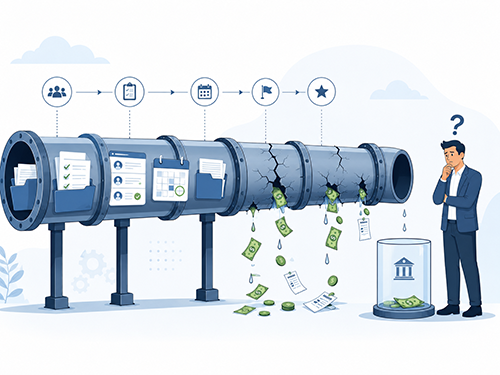

If you run a service business, your cash flow problem is rarely a cash flow problem. It is almost always a project management problem with financial symptoms.
I have spent the last several years operating inside a service business, and I have watched the same pattern play out at agencies, consultancies, design studios, and software shops of every size. Revenue looks healthy. The pipeline looks healthy. The bank account does not. Owners chase the symptom by hounding accounts receivable, extending lines of credit, or pausing hiring, and the underlying issue keeps recurring quarter after quarter.
The underlying issue is usually one of three habits. Once you see them, they are hard to unsee.
Habit One: Billing the Way You Always Have
Most service businesses bill in arrears. The work happens, then the invoice goes out, then payment lands sometime in the next thirty to sixty days. The reasoning is that this is how the industry works.
The reasoning is partly true and entirely changeable. The agencies I respect most have moved a portion of their billing to milestone-based or up-front structures, and they did it without losing clients. The way they did it was simple. They tied billing milestones to deliverables the client cares about, not to internal calendar dates. A discovery deliverable triggers a payment. A first round of design triggers a payment. A launch triggers a payment. Clients accept this structure when the milestones are real and the work is visible, because it mirrors how they spend money on every other professional service in their life.
If forty percent of your invoices currently go out at the end of the month, moving even half of that to milestone billing tightens your cash cycle by roughly two weeks. That is the same financial outcome as growing revenue by five to ten percent, with no new clients and no new hires.
Habit Two: Treating Scope Creep as a Client Service Decision
Scope creep is the second silent cash flow killer, and it almost always shows up as a generosity problem. A client asks for one more revision. The account lead says yes. Three weeks later, the team has absorbed sixty hours of unbilled work and the project is now unprofitable.
Generosity is not the issue. The issue is that the agency never decided, in advance, what counts as in scope and what counts as a change order. When that decision happens in the moment, the answer is almost always to say yes, because saying yes feels like good client service. When the decision happens in advance and in writing, the answer is a calm conversation about a small change order, which clients accept without friction.
The structural fix is to make every project agreement carry a one-page scope summary with the words this is in scope, this is not in scope, and changes to scope are billed at this rate. It takes an hour to write and it saves dozens of hours per project.
Habit Three: Confusing Utilization with Profitability
Service businesses tend to obsess over utilization, the percentage of billable hours your team is delivering. High utilization is treated as healthy. Low utilization is treated as a problem to fix.
Utilization is a useful operational metric and a poor financial one. A team with ninety percent utilization on underpriced projects loses money faster than a team with seventy percent utilization on well-priced ones. Recent professional services benchmarking from SPI Research has consistently shown that top-quartile firms outperform on margin without running the highest utilization, because their pricing and project mix do the heavier lifting.
The practical move is to pair every utilization number you track with a project margin number. If a team is highly utilized on low-margin projects, the right answer is rarely to push harder. It is usually to reprice the work, change the project mix, or both.
What Cash Flow Discipline Actually Looks Like
The service businesses with the cleanest cash flow are not the ones that chase invoices hardest. They are the ones that have built three quiet habits into their operations: billing structures tied to deliverables, scope written down before the work starts, and pricing decisions that protect margin even when utilization dips.
None of those habits cost money to install. All of them compound over time. And in a market where most service businesses are tightening their belts and watching their pipelines anxiously, the operators with these habits in place tend to look around two quarters from now and notice they are not worried.
