

I am a marketing consultant working with a small DTC menswear brand, Mariner. We make men’s underwear and base layers. We are not a celebrity-founded brand. We do not have venture money. The founder has been building the company for over a decade. By the end of year one of selling online, we were at $1.1M in annualized revenue with a marketing spend ratio of 18% and a net contribution margin that worked.
The middle year is the part nobody writes honest case studies about. Year two on a small DTC brand is brutal. The first wave of customer acquisition has saturated the cheapest channels. The platforms have raised CPMs because every DTC brand the same age as you is also trying to scale. The team is not big enough to absorb new channels but not small enough to stay scrappy.
We made the wrong call for 14 months. The right call took us 4 months to figure out and 5 months to implement. The result is a brand that is now spending 23% of revenue on marketing instead of 41%, with revenue 28% higher than the peak of the bad season.
The Mistake: Doubling What Worked at $1M
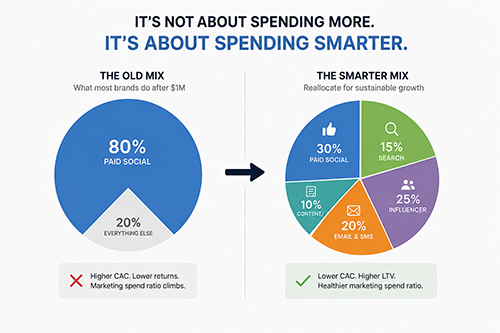
When we hit $1M our spending mix was 62% paid social, 18% paid search, 11% influencer seeding, 6% email and SMS, 3% content. That mix had been built piece by piece during the first year. Each line was tuned. The blended customer acquisition cost was $43 (AED 158) on a 90-day repeat-purchase customer worth $112 (AED 411).
When the goal became year two growth, the founder approved a budget that scaled the same mix proportionally. We went from $14,000 a month (AED 51,400) to $32,000 a month (AED 117,500) and the mix stayed almost identical. The thinking was that the mix had worked, so more of it should work better.
It did not. CAC walked from $43 to $71 (AED 260) in the first 90 days. By month 6 it was at $89 (AED 327). The 90-day repeat-purchase value did not move, because the customer was the same. The math broke. Marketing spend ratio walked from 18% to 31% in 6 months, on its way to 41% by month 14.
Here is the part that most case studies skip. We knew the math was breaking by month 4. We did not change anything for another 8 months. The reasons were ordinary. The team had been hired to run paid social. The agency partner had been signed for paid search. The influencer program had a 90-day commitment cycle. Every line item had a person attached to it and a contract attached to that person. Inertia is the real enemy in DTC year two, not channel performance.
A 2025 Shopify Plus state-of-DTC report found that 64% of DTC brands between $1M and $5M in annual revenue spend more than 35% of revenue on marketing. That number does not get talked about because it is uncomfortable. It is also the number that quietly kills these brands in year three when investor money tightens and the contribution margin is no longer enough to cover overhead.
The Audit That Restructured the Mix
By the end of month 14 the founder asked me to do something we should have done at month 6. Pull every channel apart and re-build the mix from zero, not from the inherited mix.
The exercise took 4 weeks. The deliverable was a single spreadsheet with three columns per channel: incremental revenue, full-cost CAC including agency fees and senior-team hours, and the customer profile that channel was producing.
Three findings reshaped everything.
First, paid social had become non-incremental. We ran a 14-day geo-holdout test in a single state. Revenue dropped 6% in the holdout state versus the control. The platform was reporting a 4.1 ROAS on paid social. Real incremental ROAS was closer to 1.6. Most of the spend was capturing customers who would have purchased anyway through email, organic search, or word of mouth.
Second, the influencer program was producing the lowest-cost customers but the team had been deprioritizing it because the dashboards looked unimpressive. The platform attribution gave influencer almost no credit because the click path was usually multi-touch. We tagged a cohort of customers acquired through influencer-only seeding for 60 days and watched their LTV. They were 1.7x our blended LTV.
Third, email and SMS at 6% of spend was producing 22% of revenue. We had been chronically under-investing in retention because retention does not feel like growth.
The New Mix and the 9-Month P&L
We rebuilt the mix in 5 months because every channel had a contract attached. New mix at the bottom of the rebuild: 28% paid social, 14% paid search, 24% influencer seeding, 22% email and SMS, 12% content and SEO.
Total spend stayed approximately flat in absolute dollars. The mix changed dramatically. Revenue lifted 28% in the 9 months following. Marketing spend ratio fell to 23%. Blended CAC went from $89 back to $51 (AED 187). 90-day repeat purchase rate, which we had been ignoring, climbed from 19% to 31% on the back of the email investment.
The number that surprised me the most was the influencer line. Going from 11% of spend to 24% of spend on influencer seeding produced a 41% lift in net revenue, because the channel was structurally undercredited and we had been making decisions on attribution data that was systematically wrong.
A 2025 Klaviyo benchmark study reported that DTC brands in the $1M to $5M range who allocate 18-25% of marketing spend to email and SMS see a median 23% lift in 90-day repeat-purchase rate compared with brands at the typical 6-9% allocation. Our jump from 19% to 31% repeat purchase rate is consistent with that benchmark almost to the point.
What the Right Mix Looks Like for a Year Two DTC Brand
Every brand is different. The category, the price point, the customer profile, the founder’s tolerance for ambiguity all shift the right answer. After 3 years inside Mariner and 14 conversations with other DTC marketing leads in the same revenue band, the broad pattern that has held up is this:
- Paid social as the dominant channel at year one (50-65%) is correct. By year two it should drop to 25-35% as you saturate the addressable cold audience.
- Paid search should hold steady at 12-18% across both years. It is the most underrated channel in DTC because founders treat it as boring.
- Influencer seeding should grow from 8-12% to 18-25% in year two as you have enough revenue to absorb the attribution noise and read the LTV signal.
- Email and SMS should grow from 5-7% to 18-22% in year two. The growth is mechanical: more customers, more behavioral data, more profitable retention loops.
- Content and SEO should grow from 2-4% to 10-14% in year two. SEO is the channel with the longest payback but the highest compounding rate.
Adding those up: roughly 28% paid social, 14% paid search, 22% influencer, 20% email-SMS, 12% content. Approximately what we ended up with after the rebuild, which suggests we did not invent a new approach, we just stopped fighting the math.
The Founder Conversation That Should Happen at Month 12
If you are a founder of a DTC brand approaching $1M and you are about to set the year two budget, the most useful conversation you can have is not with your agency. It is with whoever runs your finance function, even if that is you on a Sunday night with a spreadsheet.
The conversation has three questions.
First, what is the contribution margin per customer at our current CAC, and what would it need to be to absorb a 50% CAC increase without breaking the operating model? If the answer is no, you cannot scale the existing mix. You have to change the mix.
Second, which two channels in our current mix are we structurally under-crediting, and what is the smallest test we can run to see what they are actually producing? For us it was influencer seeding and email. For most DTC brands at this stage, the answer is the same.
Third, what contractual commitments are blocking us from re-allocating? In our case, an agency contract with paid social, a 90-day influencer cycle, and an email-platform contract that was undersized for what we were about to ask of it. Clearing these took 5 months.
The brands that win year two of DTC do not out-spend the field. They re-allocate. The tooling exists. The benchmarks exist. The hard part is making the call before the contribution margin gives you no choice.
If your DTC brand is hitting the wall in year two, the first move is not a new agency or a new channel. It is the audit, then the re-allocation, then the contractual cleanup. The math will not start working again until all three are done.
You can read more about the brand’s approach at marinerunderwear.com.
