


TLDR: Businesses inherit assumptions about which customers, markets and channels are worth pursuing, from templates, agencies, former employees and decisions nobody wrote down. Much of that inherited list has never been tested, and it quietly sets the outer edge of the company. You do not need to open a new market this quarter. You need to find one refusal you cannot support with evidence, and test it on purpose, with the size of the bet fixed in advance.
A few years ago I was asked to look at why a children’s robotics school could not fill its classes. The marketing was competent. Facilities, curriculum, results, all clearly presented. What was missing was any mention of the individual instructors.
I knew from my own family why that mattered. My daughter had attended a robotics club at one location with two different teachers. After one, she came out delighted and got herself up early for the next session. After the other, she was fine, mildly interested, nothing more. Same school, same room, same curriculum, and for her the two were not remotely the same activity. As a parent I was not buying a school. I was buying a person.
That business had left an entire category of information out of its marketing, not by deciding against it, but by never once asking the question. The enrollment report showed the empty seats. What it could not show was that parents were choosing a teacher, not a school.
The refusals a business cannot defend
Many companies carry a version of that gap, and most of them show up as refusals rather than omissions. Ask an owner why the business does not serve a particular state, industry, order size or customer type. In my experience the answer comes fast, and speed is the problem. A real decision usually leaves a trail behind it, a test, a spreadsheet, a bad account with a date on it. The answers I get most often leave none.
I am not arguing that these reasons are wrong. Licensing, insurance, freight cost, payment terms, warranty exposure and plain capacity rule out work permanently, and no test will change that. My claim is narrower. Most owners I have worked with cannot produce the evidence that sits underneath their own refusals. The exclusion has outlived whatever produced it, and nobody noticed, because nothing broke.
That is not a personal failing, and the numbers suggest it is close to universal. In a survey of 2,500 small-business decision-makers across the United States, Canada, the United Kingdom and Australia, conducted by Ascend2 for Constant Contact in June 2025, only 18 percent said they were very confident their marketing was effective, down from 27 percent a year earlier. The single biggest frustration the respondents named was not knowing what is working. A business that cannot tell which of its active efforts pays is in no position to know which of its refusals still holds.
Sometimes the refusal is never even stated out loud. One company I reviewed sold a treatment that has to be applied under pressure, and its marketing described the process in the technical language its industrial buyers used. On those buyers it worked. It also turned away every homeowner who read it, because a homeowner does not want the mechanism explained, they want to know the stuff gets in under the baseboard. Nobody there had decided to skip residential customers. The vocabulary decided it for them, and no report anywhere showed the cost.
The refusal that was built on the wrong number
One common way a market gets written off is that somebody compared the wrong figure and everyone downstream inherited the conclusion.
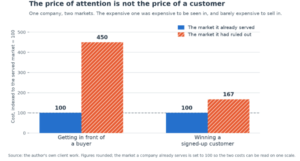
I worked with a company that had written off a market because getting into it was visibly expensive. Reaching a buyer there cost four to five times what it cost in the market the company already served. In that case the price tag happened to be a click, but it could as easily have been a booth fee, a list rental or a territory rep’s salary. Nobody had checked the number that actually pays the bills. When we finally ran it, buyers in the expensive market converted so much better that a signed-up customer cost about five dollars against roughly three in the cheap one. Attention really was several times dearer. Customers were barely dearer at all, and there were more of them to be had.
That gap between the cost of attention and the cost of a customer is where a lot of inherited refusals live. Owners rule out a trade show, a referral partner, a region or a customer segment because the entry price is visibly higher, and the entry price is often not the number that decides whether it pays.
What shows up when refusals get written down
Most refusals live in somebody’s head and leave no record, which is exactly why they go unexamined for years. They survive in writing only where some system happened to demand it: a credit policy, a territory assignment, the segment rules in a CRM, the settings in a media account. I happen to have a large sample of the last kind.
Advertising accounts are one of the few places where such a decision sometimes survives on paper. Not always. Of the 31 accounts I audited between September 2024 and February 2025, only 19 recorded any exclusions at all, which is itself telling. Among those 19, spread across five unrelated categories of online services, roughly the same ten excluded territories appeared on most of the lists, and several of those advertisers competed directly with one another. The list repeats. That is all the data proves. It does not show that anyone copied it, and one advertiser can reuse its own list many times over, so 19 accounts is not 19 independent decisions. The records also do not show when, or whether, anyone last reopened the question.
The part worth an owner’s attention is what sat next to it. In one category I could see seven direct competitors at once. One market there produced the best result of any: customers from it cost less to win and bought at a higher rate, roughly twice the return of the typical market those same companies were already serving. That market was also shut out by all seven of them. Both facts sat in the same records, and nothing suggested anyone had put them side by side.
Sometimes the inherited assumption is buried in the language rather than the map. An American firm testing British demand with the phrase it uses at home, “real estate agency,” would find almost nothing and could reasonably conclude the market was not there. The word Britons actually use is “letting agency,” and the demand behind it is enormous. The two phrases can carry comparable intent, but local usage diverges sharply. That company had not discovered an empty market. It had asked the question in the wrong language and believed the answer.
When the result is too good, it is a warning
The advice “test what you exclude” is dangerous without a stopping rule, because some markets are avoided for excellent reasons, and the reason often shows up as a result that looks spectacular.
I have watched this happen. A company opened up a market it had always avoided, and the response came back looking enormous. It was not demand. Most of what arrived was automated activity rather than customers, and of everything spent, the genuinely useful portion was smaller by orders of magnitude. The tell was never that the numbers looked bad. It was that they were not possible.
So the rule I use is simple, and it is not about advertising. Decide in advance what a believable result looks like for your business, and treat anything far above that ceiling as a defect to investigate rather than a win to scale. Then confirm the outcome outside the system that produced it. For most companies that means checking against invoices actually paid, orders that were not returned and customers who came back, rather than against the reporting screen of whichever tool generated the number. In my own work I never expand or shut down a segment on a platform’s report alone. I get the client’s actual payment records, count the same groups of customers there, and act only when the money agrees. That reconciliation is most of the work, and it is the step people skip.
Testing one refusal without betting the company
The reason owners avoid this is that “open a new market” sounds like a capital-allocation decision. Done properly it is closer to a series of small, survivable probes.
When a client wants to expand across the United States, we do not open the whole country at once. We pilot one state at a time, with the offer and the language adjusted for each, so that every result stands on its own. States behave like separate markets with separate vocabularies, and opening them together blends the outcomes into an average that teaches nothing. A company selling to New Yorkers is not selling the same thing it sells in Florida, even when the product is identical. With one client, within about six months we had stopped spending in roughly half the states we opened, because the numbers did not justify staying, and the company kept going only where the evidence was unambiguous. That is not a failure of the exercise. It is the exercise doing what a single national launch cannot, which is telling you which half is real, at a fraction of what the commitment would have cost.
Where this does not apply is worth stating plainly. If a refusal is legal, contractual or a matter of physical capacity, it is not a strategy problem and no test will change it. If you are at capacity today, opening anything new is the wrong use of attention. And a single test proves only the thing it tested. It does not license a rollout.
Here is the exercise. Write down the markets, states, segments, industries and channels your business does not pursue. Cross off everything you genuinely cannot serve. From what remains, choose the one refusal you cannot support with evidence, decide beforehand what a believable result would look like and what you are willing to spend finding out, and check the answer against money received rather than against a report. The Small Business Administration’s guidance on market research lists the questions worth answering before you spend anything, and the federal data behind most of them is free.
Much of your market map arrived with the business rather than being chosen for it. Pick the one part you cannot defend, and go find out whether it is still true.

Be the first to comment