
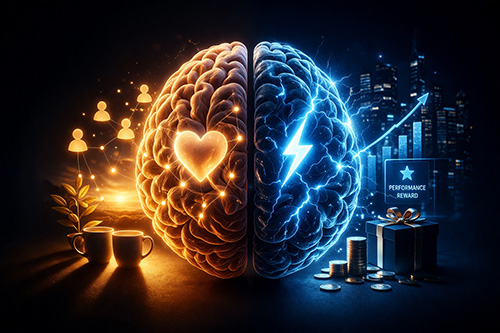

Leaders have been taught that loyalty is built through rewards, recognition, and growth opportunities. Invest financially in your people, promote high performers, give bonuses for results, and they’ll stay, right?
Biology tells a different story. That raise you just gave your best performer may have actually made them less loyal.
The problem isn’t generosity, it’s biology. The brain treats rewards differently than it treats connections. When leaders rely solely on performance-based rewards, they’re activating the wrong neurological system, which creates dopamine. Traditional rewards give your employees the equivalent of a sugar rush. And dopamine, by itself, creates craving, not commitment.
Every bonus, every promotion announcement, every “great job” email delivers a neurochemical hit. Like any addiction, employees need progressively larger rewards to feel the same satisfaction. When a competitor offers a bigger or safer hit, reward-driven loyalty collapses instantly.
Rewards do work, but only when layered onto an existing psychological bond. Without that foundation, rewards become purely transactional. This explains why organizations can have A-players in every seat and still lose talent. Without bonding chemicals, leaving doesn’t register as loss, it feels like relief.
The answer? Learn how to implement systems that serve our shared human biology. There are six chemicals that shape loyalty. These can be divided into three systems:
Bonding chemicals: (oxytocin and vasopressin) signal safety and teamwork. When these flow, the brain registers: “This person is on my side.”
Motivation chemicals: (dopamine and serotonin) drive short-term excitement and long-term satisfaction. They signal: “This person helps me feel excited and fulfilled.”
Regulation chemicals: (GABA and cortisol) balance caring with calm. Cortisol rises when someone cares deeply; GABA prevents that caring from becoming overwhelming. Together they signal: “It’s safe to care this much.”
Most teams are only using one of these chemicals, short-term motivation through dopamine-generating performance rewards. That’s why they build dependency instead of loyalty. Leaders must learn how to balance all three systems through what I call the Secure Loyalty Equation. Bonding plus Motivation divided by Regulation.
When an entire team implements this mechanism collaboratively rather than individuals pursuing it in isolation, something remarkable happens: multiplication.
Oxytocin becomes contagious as team members support each other. Vasopressin spreads through shared victories. One person’s bonding triggers another’s. Teams achieve 30-40% productivity gains, not from working harder, but from bonding deeper.
Leaders can activate this equation through three core practices:
Build Attraction Through Shared Identity: Create agenda-free moments together. Meals celebrating successes without discussing deadlines. Conversations without problem-solving objectives. Oxytocin is released when bonding occurs in the absence of stress.
Build Commitment Through Shared Challenges: Frame problems as “we” rather than “you.” When someone brings a challenge, respond immediately with “We’re going to figure this out together.” Celebrate when the team overcomes difficulty; that’s when vasopressin flows.
Create the Multiplier Effect: Model the equation yourself. Encourage peer-to-peer bonding, not just vertical relationships. Reinforce attraction and commitment when you observe it between team members.
Your team is capable of profound loyalty, but as a leader, you must be ready to stop building dependency and start building true, biologically enabled loyalty.
