

Ask a small business owner what a lead costs them right now and watch what happens. Most cannot answer. They can tell you what they spend per month, they can tell you roughly how busy the phone is, and they can tell you which competitor they resent. But the number that governs every other marketing decision they make is usually missing.
That is not a knowledge gap. It is a measurement gap, and it is the most expensive thing in the room.
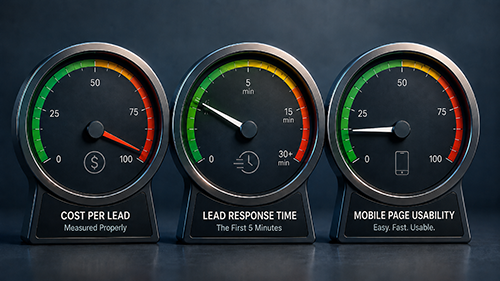
Over the past year I have looked at a lot of small and mid-sized marketing operations, and the same pattern repeats with almost boring consistency. The owner believes the problem is volume, so the instinct is to buy more traffic. The arithmetic almost always says something else. Three numbers decide whether a marketing budget compounds or leaks, and none of them require spending more.
Number one: what a lead actually costs, measured properly
Independent analyses put average Google Ads waste near 36 percent of spend for typical small business accounts. On a roughly $3,100 monthly budget, that is about $1,127 a month buying searches, audiences and placements that will never convert. Owners hear that figure and assume it applies to someone else. It usually does not.
The reason it persists is not laziness. It is that the reported numbers are wrong in a direction nobody notices. Roughly 30 to 50 percent of conversions go unreported when tracking is browser-only, which is the default state of most accounts in a post-iOS signal-loss environment. That matters far more than it sounds. Modern ad platforms are not billboards, they are optimization engines, and they learn from the conversions you report back to them. Feed an engine partial data and it does exactly what you asked: it finds more people who look like the incomplete sample. You pay for the miss twice, once in wasted spend and again in a model trained toward the wrong customer.
The fix is unglamorous. Server-side conversion tracking with working deduplication is not an optimization to schedule for next quarter. It is the prerequisite that makes every later decision meaningful. Until it exists, every performance conversation is a conversation about fiction.
Number two: how fast a lead gets answered
The second number is the one owners underrate most, because it does not feel like marketing. It feels like operations.
The response-time curve is not a gentle slope. It is a cliff between minute five and minute fifteen, then a long flat tail. A dataset of 28,400 leads originally published through MIT and Harvard Business Review, and replicated in more recent studies, shows roughly 41 percent qualification for leads worked inside five minutes against 1.9 percent after 24 hours. That is a 21-to-1 ratio produced by nothing but speed.
For home and local services the effect is even starker. Jobber’s 2026 trends report found 78 percent of customers hire the first contractor who responds, even when that contractor is neither the cheapest nor the highest rated. Meanwhile the median first response time in the category sits at 42 minutes, and only 12 percent of contractors reply inside five minutes.
Put money on it. On an HVAC replacement lead worth roughly $1,500 in expected revenue, every ten-minute slip after the first five costs somewhere around $600 to $900 in expected value. That is not a process detail to raise at the next team meeting. It is a business-model decision being made by default, usually by whoever happens to be free.
Here is what makes this number strategically interesting: it is the only one of the three that costs nothing to improve. No budget, no vendor, no rebuild. Just a decision about who answers and how fast.
Number three: whether the page can actually be used
The third number is the one owners are least equipped to see, because they are structurally the last to know.
We run a standardized check on local business websites: render the site at 390 pixels wide in a browser device toolbar, then try to do what a customer would do. Find the phone number. Tap it. Read the price. Fill out the form. All of it in under ten seconds. Four faults account for roughly 80 percent of the failures we find: text laid over a photo with no contrast layer behind it, tap targets smaller than 44 pixels, a desktop layout squeezed rather than rebuilt, and phone numbers rendered as images instead of tappable links.
The failure is silent by design. The owner checked the site on a 27-inch monitor and on their own phone, where it loads from cache. The customer who hits the broken version does not complain. They tap back and call the next name on the list. Google, meanwhile, indexes and scores the mobile version, so the desktop site nobody sees is also the one it is not ranking.
Speed compounds the problem. Research from Google and SOASTA found 53 percent of mobile visitors abandon a site that takes longer than three seconds to load, and analyses from Portent and Digital Applied estimate each additional second of mobile load time reduces conversions by roughly 4.42 percent. In construction specifically, The Atom Lab’s 2025 audit found only 3 percent of construction websites achieved a Google PageSpeed mobile score of 90 or higher, with average mobile largest contentful paint around 15.6 seconds. Google’s target is 2.5.
The gap this creates is wide enough to change a pipeline. The strongest contractor sites convert in the range of 8 to 12 percent while the median sits at 2 to 4 percent. That spread is not talent. It is mostly the four faults above, left in place because nobody looked at the site the way a customer does.
Why the order matters
These three numbers are not a checklist to work through in parallel. They are sequential, and the sequence is the actual strategy.
Measurement comes first, because without it you cannot tell whether anything else worked. Response speed comes second, because it is free and it converts leads you have already paid for. The page comes third, because rebuilding before you can measure the result is how businesses spend money twice.
Only after those three are settled does buying more traffic make sense. At that point additional budget compounds, because every dollar enters a system that measures honestly, answers quickly, and converts on the device customers actually use.
The uncomfortable part is that none of this is a growth tactic. It is maintenance. It does not photograph well, it will not impress anyone at a conference, and it is the closest thing to free money most small businesses have available.
If you cannot name your cost per lead today, that is where the work starts. Not with a bigger budget. With a number.

Be the first to comment