
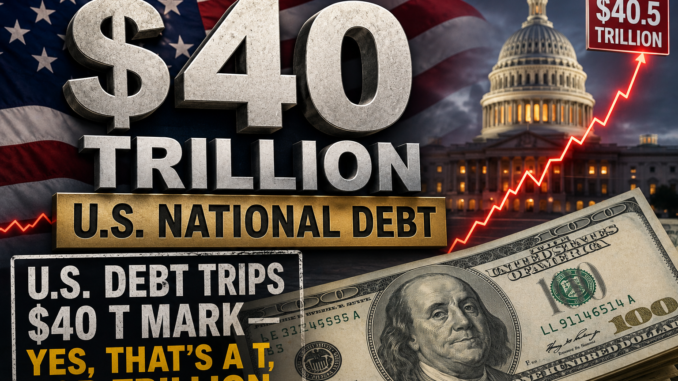

In a dubious milestone, the national debt of the United States tipped the $40 trillion mark
last week, capping a decade-length spending spree that has brought the ire of not only
fiscal hawks, most of whom seem to have gone silent during this stretch, but financial
observers and analysts who forewarn the country may not be able to sustain a financial
crisis thanks to its debt load.
The Treasury’s financial report from August 18, 2026, showed that the nation’s debt
reached $40.5 trillion, more than double its level one decade ago. Though carrying financial
debt is not anything new, the rate of increase has been alarming.
“We’ve been running deficits for the last 26 years, and we’ve basically ignored a lot of the
structural challenges that exist in our budget that are very well known,” said Michael
Peterson, CEO of the nonpartisan Peter G. Peterson Foundation. “It’s clearly been
accelerating because, like any debt problem, the longer you ignore it, the worse it gets.”
The frantic pace at which the debt has increased may be most alarming. For the first time in
its history, the U.S. Government spends more servicing the national debt than it does on
national defense or Medicare.
Analysts warn the nation’s debt growth is not going to slow down. Net interest costs, which
approached $1 trillion in 2025 and accounted for nearly 14% of the nation’s spending, are
only part of the problem.
The number of people collecting Social Security and Medicare has expanded, as the
second wave of Baby Boomers continues to retire. Large economic crises such as the
Great Recession of 2008 and the Covid 19 pandemic triggered large spikes in the nation’s
spending and debt burden. Tax cuts over the last two decades, including the Trump
administration’s One Big Beautiful Bill, will add $4.2 trillion to the national debt through
fiscal year 2034.
When President Donald Trump was sworn in for his first term in January 2017, the nation’s
debt was $19.95 trillion. One-third of the increase since then occurred during the two years
of frantic government borrowing to fund the Covid 19 pandemic response undertaken by
Trump and subsequently President Joe Biden. The fiscal policies of both administrations,
combined with long-running tax-and-spending imbalances account for the rest of the
ballooned total.
Since Trump returned to office for his second term in January of 2025, the debt has
increased by $3.8 trillion. During the Biden administration, the debt increased $8.5 trillion
during his four years in office.
Fiscal hawks and budget watchdog groups have sounded stark warnings that a major debt
crisis could emerge if lawmakers do not confront the unsustainable fiscal pace with tax
increases, spending cuts or both.
“Forty trillion dollars of debt doesn’t exist solely on the government’s ledgers; it is felt
throughout the economy and finds its way to the pocketbooks of people one way or
another,” said Maya MacGuineas, president of the nonpartisan Committee for a
Responsible Federal Budget.
“The more we borrow, the more we exacerbate inflation, squeeze out other priorities in the
budget, and leave ourselves vulnerable to emergencies at home and turmoil abroad,”
MacGuineas said in a statement just after the Treasury data was released.
The news came days after U.S. Treasuries reached their highest yields since 2021, and long
bonds hit their highest levels in nearly two decades. A day later, U.S. Treasury Secretary
Scott Bessent took a bold step to push long bond yields back down, announcing a doubling
of buyback sizes for 10-to-30-year Treasuries to at least $4 billion per operation. Higher
Treasury yields at the long end tend to drive up borrowing rates for home mortgages, auto
loans and commercial loans.
When asked if the public should be concerned about the bond sell off, President Trump
responded: “I don’t think so at all. I think we have a very powerful country, and we’re
powering through these ridiculous interest rates…they’re ridiculous. Look, when our
country is strong, interest rates should go down.”
The Treasury also reported the fourth highest monthly deficit in U.S. history–$432 billion for
July—as tariff refunds continued and outlays for Social Security and Medicare increased.
The deficit for the first ten months of fiscal year 2026 has already exceeded the total gap for
fiscal 2025—and two months remain in the current fiscal year.
Public debt rose by $7.8 trillion in Trump’s first term, more than half of that amassed during
his last nine months in offense during the Covid response rollout.
The $8.5 trillion increase during Biden’s term was marked by heavy Covid recovery
spending but was also driven by big ticket items such as infrastructure investment and
clean energy subsidies.
Both the Trump and Biden administrations accelerated the federal debt trajectory beyond
what the existing spending statues were when each took office.
While Trump intended to focus his second administration on cost-cutting, exemplified by
the non-governmental Department of Government Efficiency, resulting in numerous cuts to
federal jobs, much of those cuts were so-called “discretionary” programs, which make up
the smallest portion of the federal budget.
And the passing of his One Big Beautiful Bill Act, and the costly Middle East war, has only
increased debt spending.
The U.S. spends roughly 60% of its annual budget on so-called “mandatory” programs,
which includes payments for Social Security, Medicare, Medicaid and veterans’ care, all of
which grow to keep up with increased living costs.
Higher interest payments on the debt also increases the risk of “crowding out”, meaning it
becomes more of a challenge for the federal government to fund those core programs.
While many believe the out-of-control debt could cripple the U.S. economy especially if an
international crisis emerges or the AI-buildout boom turns to a bust, some feel the
government can, providing a strong U.S. economy, can continue to shoulder the burden.
Dean Baker, co-founder of the economic think tank Center for Economic and Policy
Research notes that the more immediate threat to the American economy is tariffs and the
impact of the Iran war on prices, as well as the fear of investors backing out if they sense
the AI bubble were to burst.
“If people just become wary of U.S. markets and the U.S. economy, they might pull their
money out,” he said. “So I think there is an issue with foreign money leaving the U.S. but the
government debt isn’t the biggest factor, and probably not even a major factor.”

Be the first to comment