
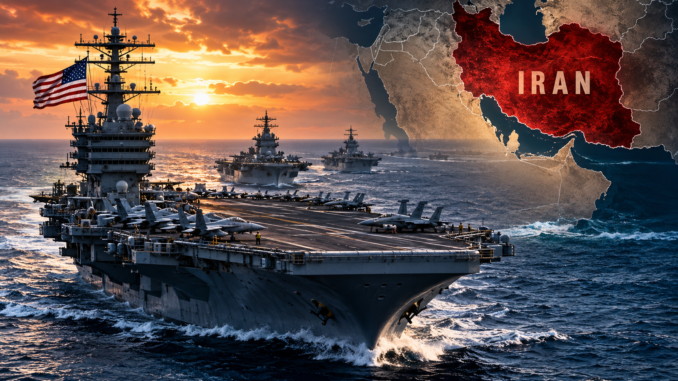

In what could be the clearest sign of renewed attacks on Iran, the U.S. military is dispatching 9,000 troops aboard a group of ships to the Middle East, including a third aircraft carrier, a U.S. official announced on Thursday. The increased military presence comes on the heels of President Donald Trump’s warning that further strikes on Iran could be imminent.
One week after a gathering at U.N. General Assembly, which included exchanges between the U.S. and mediators on behalf of Iran revolving around brokering a peace settlement, the troop movement underscores the rapidly evolving dynamic in the Middle East, and the nature of the conflict with Iran becoming more complex.
With the troop buildup, the possibility of a post-election escalation seems more likely, despite Trump’s constant proclamations that the conflict would only last a matter of weeks initially, and more recently that an agreement would be reached immediately after the midterms.
As for last week’s exchanges at the U.N., Trump said he rejected Iran’s latest ceasefire proposal because “things that I wouldn’t have approved a year ago I wouldn’t have today”.
Trump referenced an offer from Iran to “open up” the Strait of Hormuz, the vital waterway transporting oil and fuel, as “not good enough”.
As for the buildup itself, the ships now enroute to the Middle East, including 7,000 sailors and 2,000 Marines, also include the USS Theodore Roosevelt carrier strike group. Including the military already in place, that could bring the U.S. presence in the region to more than 20,000 sailors and Marines as well as hundreds of aircraft. The Navy previously had three carrier strike groups in the Middle East in April for the first time since 2003.
Trump was asked if the increasingly unpopular war would threaten the Republican Party in the upcoming midterm elections, to which he responded, “it’s possible”, but then pivoted to “it should help because Iran won’t have a nuclear weapon.”
“So, when you say it that way, it would help,” said Trump. “If you don’t say that, it could hurt.”
Yet there is growing concern that Tehran could assume more asymmetrical tactics following the FlyDubai airline attack on Wednesday, in which the jet co-pilot stabbed the captain and tried to crash an Israeli-bound flight.
Trump did suggest on Thursday that there may be a link between the attacking co-pilot and Iran. When questioned by reporters on the possibility, Trump reiterated, “I would say the answer, based on what I’m hearing, is ‘yes,’ but we’re working on it right now,” without offering more concrete details.
Trump did add that if the link to Iran is established, the U.S. would retaliate.
“Oh, they’ll be hit very hard, don’t worry,” Trump said. “You just ask them. They know what happened. They’ll be hit very hard.”
Israeli Prime Minister Benjamin Netanyahu claimed in an interview with Fox News on Thursday that investigators believe the FlyDubai suspect underwent “Islamist, radical indoctrination,” but did not provide further details.
Authorities believe that Tehran may be looking to shift strategy as the U.S. loosens their grip over the Strait of Hormuz and begins to find alternatives in getting Gulf allies oil to market, while shutting down Iran’s oil exports via the Naval blockade.
British authorities announced on Thursday the arrest of a dual U.K.-Iranian national on suspicion of plotting a terror attack following a security incident at a U.S. run military airbase in England that British authorities have linked to Tehran.
This followed the arrest of five British nationals from London on Sunday on suspicion of explosives and terror offenses close to the RAF Fairford airbase, which has been used by American bombers to strike Iran.

Be the first to comment