
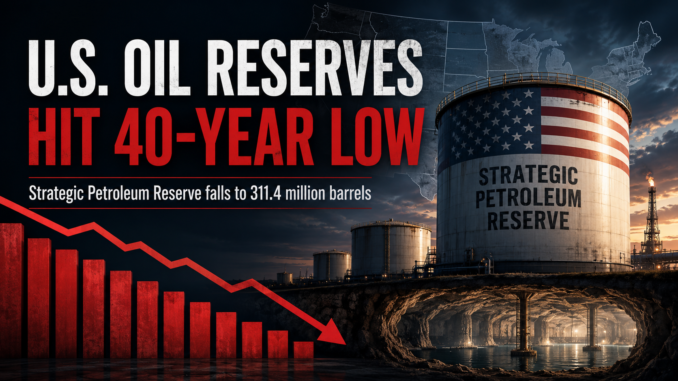

While the United States remains the world’s largest oil producer, pumping roughly 13.5 million barrels of crude oil per day, its Strategic Petroleum Reserve has fallen sharply.
U.S. crude holdings in the Strategic Petroleum Reserve dropped by a reported 5.1 million barrels last week to 311.4 million barrels, the lowest level since March 1983, according to the Department of Energy.
The decline stems largely from a U.S. pledge to release 172 million barrels from the reserve following the outbreak of the conflict with Iran. According to reports, SPR inventories have fallen by as much as 104.4 million barrels since the conflict began on February 28.
On March 11, the Trump administration announced the 172-million-barrel release as a way to offset potential supply disruptions caused by the conflict, particularly any interruption of shipping through the Strait of Hormuz.
The U.S. release was part of a broader 400-million-barrel coordinated action by the International Energy Agency involving 32 countries.
However, the current drawdown differs from many previous uses of the SPR.
Rather than simply selling the crude, the federal government is effectively lending oil to companies, which are required to return the same volume at a later date along with an additional premium.
Since mid-March, the Department of Energy has contracted out more than 133 million barrels, with repayment premiums on individual deals reportedly ranging from 18% to as high as 28%.
According to U.S. Energy Secretary Chris Wright, the government expects to receive approximately 1.2 barrels in return for every barrel released.
As of July 10, combined commercial and SPR crude inventories in the United States stood at 726.2 million barrels, down 129 million barrels and at their lowest level since 1984.
Concerns have also emerged over the physical condition and operating capacity of the reserve itself.
According to S&P Global, a Government Accountability Office report issued in July found that the SPR could draw down crude at only about 61% of its originally intended rate, while its ability to accept returning crude had fallen to roughly 56% of its design capacity.
“The SPR’s operational capability to meet mission demands is at risk,” the GAO report said.
The GAO also found that the reserve’s $1.4 billion Life Extension Phase 2 overhaul has fallen behind schedule and been reduced in scope after more than a decade of planning and development.
The Department of Energy has not issued a major update to its SPR strategy in nearly a decade.
Even after the recent drawdowns, the reserve’s 311.4 million barrels remain above the statutory minimum of 252.4 million barrels, a threshold that limits certain drawdowns under the Energy Policy and Conservation Act.
Created in response to the energy crises of the 1970s, the Strategic Petroleum Reserve stores crude oil in underground salt caverns along the Gulf Coast and has a nominal storage capacity of roughly 714 million barrels.
