


There is a moment every product owner knows well. You are sitting in a sprint planning session, staring at a backlog that is three times longer than your team can realistically deliver, and someone asks the question that cuts through all the noise: “What absolutely has to ship, and by when?”
That question — deceptively simple, surprisingly powerful — is the one I started asking myself about my retirement savings. And it changed everything.
I have spent more than a decade building and launching consumer-facing digital products. From the survey matching platforms at Union Street Enterprises to the resume distribution services I founded and eventually sold to LiveCareer, my professional life has been defined by deadlines, deliverables, and the discipline of prioritization. When I launched MintWit in 2025 as a personal finance education resource, I did not intend to write about retirement planning through the lens of product development. But the more I examined my own financial trajectory, the more I realized that the frameworks I use to ship great products are the same ones that lead to a fully funded retirement — and that most people, particularly small and medium-sized business owners, are missing the connection entirely.
This article is my attempt to draw that line clearly.
The Core Insight: Retirement Is a Product With a Launch Date
In product management, we use roadmaps to communicate what we are building, why it matters, and when it needs to be done. Every feature on that roadmap has a deadline. Some deadlines are soft — nice targets we aim for. Others are hard — immovable constraints tied to market conditions, regulatory requirements, or competitive pressures.
Your retirement is a product with a hard launch date.
You may not know the exact date yet, but the financial machinery that will power your post-work life — your 401(k), your IRA, your investments, your Social Security strategy — is being built right now, feature by feature, contribution by contribution. Every year you delay a contribution is a feature you chose not to ship. And unlike a software release that can be pushed to the next sprint, the compounding interest clock does not offer you a hotfix.
This realization hit me hardest when I started researching retirement data for MintWit. The numbers are sobering. According to the Federal Reserve’s Survey of Consumer Finances, the median retirement account balance for Americans aged 55 to 64 — those within a decade of traditional retirement age — is approximately $185,000. (Source: Federal Reserve Survey of Consumer Finances 2022). For most financial planners, a comfortable retirement requires significantly more. The gap between where people are and where they need to be is not primarily a knowledge problem. It is a prioritization problem.
And prioritization, fortunately, is something product owners know how to fix.
Defining Your MVP: Minimum Viable Portfolio
In product development, the MVP — the Minimum Viable Product — is the smallest version of your product that still delivers meaningful value to users. It is not the final version. It is the version that gets you into the game.
Your retirement savings have an MVP too.
Before you can optimize, tax-shelter, and strategically invest, you need to define what “minimum viable” looks like for your financial future. For most working Americans, this starts with understanding the contribution limits and tax advantages of employer-sponsored retirement plans.
For 2025, the IRS has set the 401(k) employee contribution limit at $23,500 for individuals under age 50. For those aged 50 and over, the catch-up contribution limit allows an additional $7,500, bringing the total to $31,000. And for those aged 60 to 63, a newly enhanced catch-up contribution under the SECURE 2.0 Act allows up to $11,250 in additional contributions, for a total of $34,750. (Source: IRS 401(k) Limit Announcements for 2025)
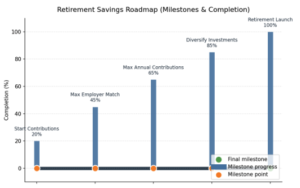 Think of these limits as your product specifications. They define the maximum scope of what you can build in a given year. Your MVP is contributing at least enough to capture any employer match — because failing to do so is the financial equivalent of shipping a product with a known, fixable bug and calling it done.
The Roadmap Framework: Breaking Retirement Into Sprints
Agile product development works in short cycles called sprints — typically two-week periods during which the team commits to delivering a specific set of features. At the end of each sprint, you review what was accomplished, assess what did not make it, and reprioritize the backlog.
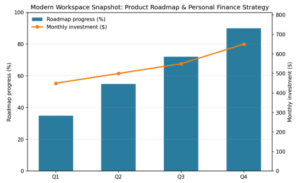
I apply an almost identical structure to my retirement planning, with one critical modification: my sprints are quarterly.
Sprint 1: Audit Your Current State (Q1)
Every good product roadmap starts with an honest assessment of where you are. In January of each year, I sit down with my financial picture the same way I would sit down with a product audit. I ask:
- What did I contribute last year, and did I hit my targets?
- What is my current portfolio allocation, and does it still match my risk tolerance and time horizon?
- Have my income, expenses, or life circumstances changed in ways that require me to update my financial roadmap?
- Are there any new tax-advantaged vehicles I am not currently using?
This audit is not glamorous. But it is the foundation of everything that follows. In product terms, you cannot build the right next feature if you do not understand the current state of your product.
Sprint 2: Set Contribution Commitments (Q2)
By the second quarter, I have translated my audit findings into hard commitments — not aspirations, but scheduled, automated contributions that treat my retirement account like a non-negotiable line item.
This is where many people, especially business owners, make a critical mistake. They tell themselves they will contribute “whatever is left over” at the end of the month. In product management, that logic would be catastrophic. You do not build the most important features with whatever engineering capacity is left over after lower-priority work is done. You protect the time, allocate the resources, and guard the deadline.
Automating your 401(k) contributions — treating them as a fixed infrastructure cost rather than a discretionary expense — is the single most powerful behavioral intervention available to retirement savers. Research published by Vanguard in their annual How America Saves report found that automatic enrollment in 401(k) plans dramatically increases participation rates, with plans featuring automatic enrollment showing participation rates of 93% compared to 70% for voluntary enrollment plans. (Source: Vanguard How America Saves 2024)
Sprint 3: Optimize and Diversify (Q3)
The third quarter is when I shift from “are we contributing?” to “are we contributing smartly?”
This sprint focuses on:
- Asset allocation review: Am I appropriately balanced between equities, fixed income, and alternative assets given my time horizon?
- Tax strategy: Should I be maximizing traditional pre-tax contributions, Roth after-tax contributions, or a combination of both?
- HSA maximization: For those with high-deductible health plans, a Health Savings Account is a triple-tax-advantaged vehicle that pairs powerfully with retirement planning. For 2025, the HSA contribution limit is $4,300 for individual coverage and $8,550 for family coverage. (Source: IRS HSA Limits 2025)
- SEP-IRA or Solo 401(k) considerations: For self-employed individuals and small business owners, these plans offer dramatically higher contribution ceilings than standard employee 401(k) plans and deserve serious attention.
Sprint 4: Year-End Review and Retrospective (Q4)
Every agile team ends each major development cycle with a retrospective — an honest, structured conversation about what worked, what did not, and what to change going forward.
By Q4, I am asking: Did I hit my annual contribution targets? What life events — income changes, major expenses, family changes — affected my retirement roadmap this year? What adjustments do I need to make heading into the next year?
I also use Q4 to evaluate Roth IRA conversion opportunities. If my taxable income is lower in a given year, this may be an optimal window to convert a portion of traditional IRA assets to Roth status — paying taxes now at a potentially lower rate in exchange for tax-free growth and withdrawals later.
The Backlog Problem: Why Business Owners Are Especially Vulnerable
One of the most common failure modes I see in product development is the infinite backlog — a list of features and improvements so long that the team becomes paralyzed, constantly reprioritizing rather than shipping anything.
Small and medium-sized business owners face an analogous crisis with their personal finances.
Running a business is an all-consuming endeavor. Cash flow demands, employee concerns, operational challenges, marketing strategy, and competitive pressures fill every available hour. Retirement planning consistently lands at the bottom of the priority list — not because business owners do not know it matters, but because the urgency never feels as immediate as the next payroll cycle, the next client negotiation, or the next hiring decision.
The data reflects this reality. According to a 2023 survey by SCORE (the nation’s largest network of volunteer expert business mentors), 34% of small business owners have no retirement savings at all, and fewer than half have any formal retirement plan in place. (Source: SCORE Small Business Retirement Survey)
This is the backlog problem applied to personal finance — and the consequences are severe. Unlike a product backlog, where a delayed feature can be shipped in a future sprint, retirement savings carry an irreplaceable resource: time. The compounding effect of early and consistent contributions cannot be replicated by larger contributions made later.
To illustrate: if a 35-year-old contributes $500 per month to a retirement account earning an average annual return of 7%, they will accumulate approximately $1.2 million by age 65. A 45-year-old making the same monthly contribution under the same conditions will accumulate approximately $567,000 — less than half the amount, despite contributing for only ten fewer years. (Source for compound interest calculations: SEC Investor.gov Compound Interest Calculator)
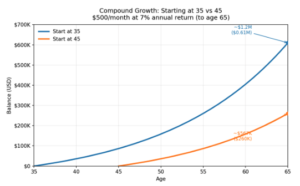 Time is the most valuable feature in your retirement product. And unlike sprint capacity, you cannot negotiate more of it.
Employer Matching: The Free Feature You Should Never Leave on the Table
In product development, we occasionally encounter what I call “free wins” — improvements that require minimal engineering effort but deliver outsized value to users. Experienced product owners learn to prioritize these aggressively.
Employer matching on 401(k) contributions is the free win of personal finance. It is an immediate, guaranteed 50% to 100% return on your investment, depending on your employer’s match formula, up to the matched contribution ceiling.
Yet according to data from Vanguard’s How America Saves 2024 report, approximately 25% of eligible employees do not contribute enough to capture their full employer match. (Source: Vanguard How America Saves 2024)
This is the equivalent of a product team declining to ship a feature that requires no development time and makes users measurably happier. There is no defensible rationale. Capturing the full employer match must be the first line item on every retirement roadmap, before any other financial priority.
Self-Employed Owners: Building Your Own Benefits Architecture
When I sold ResumeDirector and ResumeArrow to LiveCareer and subsequently built new consumer products under the Union Street Enterprises umbrella, I transitioned through periods of both employee and entrepreneur status. The contrast was illuminating.
As an employee, retirement benefits are partially constructed for you. Your employer establishes the plan, handles compliance, and often contributes matching funds. As a self-employed entrepreneur or small business owner, you are responsible for architecting the entire system yourself.
This is where many business owners dramatically undersave — not from neglect, but from unfamiliarity with the tools available to them.
SEP-IRA: The High-Limit Solution
A Simplified Employee Pension IRA (SEP-IRA) allows self-employed individuals and small business owners to contribute up to 25% of net self-employment income, with a maximum contribution of $70,000 in 2025. (Source: IRS SEP-IRA Contribution Limits)
For a business owner earning $200,000 in net self-employment income, this means potential contributions of up to $50,000 per year — more than double the standard 401(k) employee limit. The SEP-IRA is administratively simple to establish and maintain, making it an ideal starting point for entrepreneurs who want maximum contribution capacity with minimal compliance overhead.
Solo 401(k): The Power User Option
For self-employed individuals without employees (or with only a spouse as an employee), the Solo 401(k) — also called an Individual 401(k) or One-Participant 401(k) — offers the most powerful combination of contribution capacity and flexibility.
Unlike the SEP-IRA, the Solo 401(k) allows contributions in two roles:
- As an employee: Up to $23,500 in 2025 (with catch-up provisions for those 50 and over)
- As an employer: Up to 25% of compensation
The combined total cannot exceed $70,000 in 2025 (or $77,500 with catch-up contributions for those 50-59 or 64 and older). (Source: IRS One-Participant 401(k) Plans)
Critically, the Solo 401(k) also offers the Roth contribution option — giving high-earning entrepreneurs the ability to make after-tax contributions that grow and are withdrawn tax-free, a significant long-term advantage for those who expect their tax rate to rise in retirement.
The Product Owner’s Anti-Patterns in Retirement Planning
In product management, we study anti-patterns — common behaviors that appear reasonable but consistently lead to poor outcomes. I have identified several retirement anti-patterns that business-minded professionals should recognize and actively avoid.
Anti-Pattern 1: Perpetual Backlog Refinement
This is the person who spends enormous energy researching the perfect retirement strategy — reading every article, comparing every fund, debating Roth versus Traditional — but never actually starts contributing. Analysis paralysis is the enemy of compound growth. A good strategy implemented today is worth exponentially more than a perfect strategy implemented five years from now.
Anti-Pattern 2: The “After the Business Sells” Fallacy
Many small business owners treat their company as their primary retirement vehicle — planning to sell the business and live on the proceeds. This is not inherently wrong, but it is dangerously incomplete. Business valuations are unpredictable. Markets contract. Industries disrupt. Buyers disappear. Relying exclusively on a future business sale, without building independent retirement assets, is the equivalent of shipping a product with no redundancy — one failure point takes down the entire system.
Anti-Pattern 3: Lifestyle Creep Without Contribution Scaling
As businesses grow and personal income rises, many owners scale their lifestyle before they scale their retirement contributions. The discipline of increasing your contribution rate proportionally with income increases — treating contribution scaling as a required feature of any income growth — is one of the most powerful habits in long-term wealth building.
Anti-Pattern 4: Ignoring Sequence-of-Returns Risk
As you approach retirement, the order in which your investment returns occur matters enormously — a phenomenon called sequence-of-returns risk. A significant market downturn in the early years of retirement can permanently damage a portfolio’s longevity, even if long-term average returns are positive. Sophisticated retirement planning includes gradual de-risking of the portfolio as the retirement launch date approaches — the financial equivalent of feature freeze before a major release.
The Roadmap Is Not Just About You: Succession Planning and Retirement Alignment
For business owners in particular, personal retirement planning does not exist in isolation. It intersects with business succession planning in ways that most entrepreneurs fail to anticipate.
If your exit from the business is part of your retirement funding strategy, then your succession plan is, in effect, a retirement planning document. The timing of your exit, the valuation of your business, the structure of any sale or transfer, and the tax implications of that transaction will all directly affect your retirement resources.
A few critical considerations:
- Business valuation: Do you have a current, professionally conducted business valuation? Knowing your business’s worth is the starting point for any succession-driven retirement strategy.
- Exit timeline: When do you want to exit, and is your business positioned to command maximum value by that date? Aligning your business development roadmap with your retirement timeline is essential.
- Tax structure of the sale: Asset sales versus stock sales carry dramatically different tax consequences. Working with a qualified tax advisor well in advance of any exit can save hundreds of thousands of dollars.
- Buy-sell agreements: For businesses with multiple owners, a properly structured buy-sell agreement funded by life or disability insurance ensures that a partner’s exit — voluntary or otherwise — does not derail your retirement plan.
The integration of business succession planning with personal retirement planning is one of the most underserved areas in small and medium-sized business advisory. The business owners who navigate it best are those who begin the planning process years — ideally decades — before their intended exit date.
What the Metrics Tell You: KPIs for Retirement Progress
In any product I have managed, I have insisted on clear, measurable key performance indicators — KPIs that tell us objectively whether we are on track or falling behind. Retirement planning deserves the same rigor.
Here are the retirement KPIs I track annually:
1. Savings Rate
What percentage of your gross income is going toward retirement savings? Most financial planners recommend a savings rate of 10-15% for those who start early, and significantly higher for those who begin later. This is your primary throughput metric.
2. Replacement Rate
What percentage of your pre-retirement income do you expect to replace through retirement income sources? A common target is 70-90% of pre-retirement income, accounting for reduced expenses in some categories but potentially increased healthcare costs.
3. Retirement Readiness Score
Many brokerage platforms and financial planning tools now offer a retirement readiness score — a composite metric that evaluates your current savings, contribution rate, projected Social Security income, and assumed retirement date to estimate your probability of maintaining your desired standard of living throughout retirement. Treat this score like your product’s health dashboard. Review it annually, and take action when it trends in the wrong direction.
4. Asset Allocation Drift
Markets move. As certain asset classes outperform, your portfolio allocation drifts from its target. Monitoring and periodically rebalancing your portfolio — returning it to your target allocation — is the retirement equivalent of ensuring your product’s architecture does not accumulate technical debt.
Starting From Zero: The Small Business Owner’s First Sprint
If you are reading this as a small or medium-sized business owner who has not yet established a formal retirement plan, the most important thing I can tell you is this: start today, and start simply.
The perfect retirement plan you will implement next year is worth far less than the imperfect plan you implement this month. Here is a simple first sprint:
- Open a SEP-IRA or Solo 401(k) (depending on whether you have employees) through a reputable brokerage. Major providers such as Fidelity, Vanguard, and Schwab offer these accounts with no setup fees.
- Contribute a fixed dollar amount or percentage of this month’s income — even if it is modest. The habit is the product. The dollar amount is a feature you will improve in future sprints.
- Automate future contributions so that funding the account happens without requiring an active decision each month.
- Review your contribution amount quarterly and increase it whenever you can.
- Consult a financial advisor or CPA to optimize your plan structure, contribution strategy, and tax approach as your assets grow.
The roadmap does not need to be perfect on day one. It needs to exist, and it needs to be moving.
Conclusion: The Launch Date Is Coming
Every product I have ever built has had a launch date. Some were exciting. Some were terrifying. All of them arrived whether we were ready or not.
Your retirement will arrive the same way.
The frameworks that make product owners effective — rigorous prioritization, sprint-based execution, honest retrospectives, hard deadlines, and relentless focus on delivering value — translate with remarkable fidelity to the domain of personal finance. The discipline is the same. The stakes, arguably, are even higher.
At MintWit, my mission is to make sophisticated financial thinking accessible to everyday people, whether they are building a business, supplementing their income, or navigating the complex terrain of retirement planning. And the most important insight I can offer from that work, and from my years as a product professional, is this: treat your retirement like a product that has to ship.
Set the hard deadline. Build the roadmap. Run the sprints. Ship the contributions.
Because unlike a software release, this is one launch you do not get a second chance to reschedule.
