
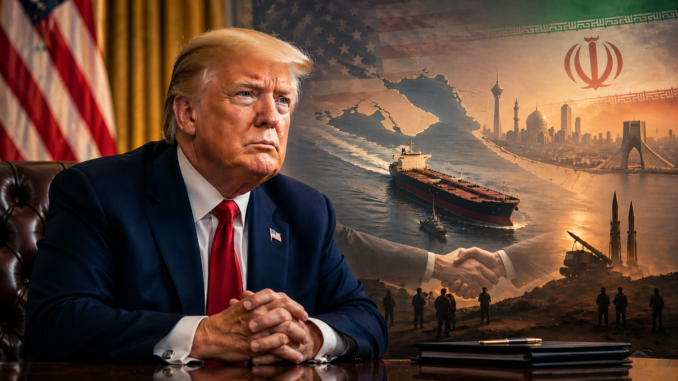

President Donald Trump met with his security team again last Tuesday, to debate what the
next move should be in the ongoing conflict with Iran. Trump’s latest deadline–demanding
the Iranians open the Strait of Hormuz, allowing free traffic for all, and agree to terms with
their enriched uranium stockpile and other factors or face a re-escalation of military
strikes—was fast approaching. A rescheduling of diplomatic talks in Islamabad was not yet
confirmed, and any response through their Pakistani mediator, Field Marshal Asim Munir,
yielded nothing.
Whether the Iranians were purposefully remaining silent, or, given to how badly their
telecommunications infrastructure was damaged, therefore making even communication
amongst themselves impossible, was not exactly clear.
Trump’s top aides believed the lack of response was due to their current leadership being
so badly fractured, they could not dispatch communications to Pakistani mediators. Or
they could not reach any sort of consensus regarding the Strait or the stockpile of enriched
uranium.
Many believe the current stated Supreme Leader, Mojtaba Khamenei, is perhaps a
figurehead, and could possibly be physically compromised, and the country is being run by
numerous hardline leaders of the military.
Whether Khamenei is at odds with the military leadership or communication is so
compromised that the various parties cannot reach consensus, U.S. officials believe his
efforts to remain hidden have disrupted internal Iranian government discussions.
With no clear path to future discussions confirmed or any certainty that they will even
happen, Trump opted to extend the current ceasefire, and this time, did not specify an end
date.
Trump acknowledged that the Iranians had a limited time frame in which to respond but
has not made clear what the timeframe is.
In the meantime, the blockade on Iranian ports in the Strait remains, despite Tehran’s
insisted that the blockade must be removed before talks resume. Trump maintains the
blockade will stay in place until a deal is reached.
The current blockade has seriously affected both countries’ economies, as Iran has seen
90% of its maritime business shut down, including vital oil exports, while the current price
of Brent crude is back over $105 per barrel, and the U.S. benchmark, West Texas
Intermediate, is between $94-$99 per barrel, further straining energy costs in the U.S.
Without a deadline, some Trump advisors have claimed that the Iranians will likely try to
drag out the negotiations, giving them time to unearth some of their missile systems that
have been buried over the course of the war.
Among the finer details of any plan would be Iran’s future ability to enrich uranium, what
becomes of its current stockpile of enriched uranium and what sanctions on the country
are to be lifted, if any—all critical points, and all still unresolved, according to individuals
reportedly familiar with the talks.
Trump remained resolute in the Oval Office yesterday when he met with reporters, stating
he is in “no hurry” to get a deal worked out. “I don’t want to rush it, I want to take my time,
and I want to get a great deal,” said Trump. “I want to get a deal where our nation and the
world is safe from lunatics with nuclear weapons.”
