


For consultants working with Small and Mid-Sized Business Clients
The Reality of the Small Business Owner
Small business owners are among the hardest-working individuals you will encounter. They are constantly solving problems, approving jobs, managing employees, handling customers, negotiating with vendors, and keeping operations moving forward. They are the driving force behind their business, but they are also, often unintentionally, its greatest limitation.
Consultants see this clearly. Owners often do not.
From the owner’s perspective, their constant involvement feels both necessary and justified. They believe their presence is what keeps everything together, and the idea of stepping back, introducing structured meetings, or empowering others to lead can feel risky, unnecessary, or even counterproductive. Concepts like weekly management meetings are frequently dismissed as “extra work” or “corporate overhead,” rather than tools that improve performance.
This is where effective consulting begins.
Our role is not to present theory, but to translate structure into something practical, necessary, and immediately relevant to the owner’s daily experience. When positioned correctly, weekly management meetings and team empowerment are not abstract concepts; they are the foundation for reducing chaos, improving efficiency, and creating a business that can grow sustainably without constant owner intervention.
Start with the Owner’s Experience, Not the Recommendation
The conversation must begin with the owner’s reality, not the recommendation. When consultants open by suggesting weekly management meetings, most owners instinctively disengage because it sounds like just another demand on their already limited time. However, when the discussion starts with their lived experience, the dynamic shifts. For example, instead of leading with the solution, a consultant might say, “How often do you get pulled into questions throughout the day that your team could have handled if they had clarity?” or “How many times this week did a job slow down because someone was waiting on your decision?” When owners reflect on the constant interruptions, the pressure of being the sole decision maker, and the frustration of projects stalling while employees wait for direction, they begin to recognize themselves in the conversation and become far more receptive.
These challenges are not personal shortcomings; they are structural issues in how the business is currently operating. For instance, when a sales team promises a timeline that operations cannot meet, or when a manager brings a problem to the owner instead of proposing a solution, the issue is not a lack of effort but a lack of a consistent system for communication and accountability. When owners internalize these patterns as a reflection of their own performance, they tend to work harder by taking more calls, answering more questions, and staying later, rather than working differently. This only reinforces the cycle. By helping them see that these frustrations are predictable outcomes of operating without a defined management rhythm, consultants can shift the conversation away from blame and toward clarity.
This shift in perspective is critical. Once owners understand that their daily challenges are symptoms of a missing structure rather than a lack of capability, they become far more open to change. At that point, introducing weekly management meetings no longer feels like an added burden. Instead, it becomes a practical solution, a dedicated time where managers bring updates, align on priorities, and resolve issues before they reach the owner. What once felt like just another meeting is now understood as the mechanism that eliminates the very interruptions and inefficiencies the owner deals with every day.
Reframing the Purpose of the Weekly Management Meeting
To gain genuine buy in, consultants must redefine what a meeting represents in the context of a small business. Many owners associate meetings with inefficiency or wasted time, so the conversation must shift away from the idea of a “meeting” and toward the outcomes it produces. One effective way to do this is by grounding the conversation in real scenarios the owner experiences. For example, instead of saying “you need a meeting,” a consultant might say, “Right now, your team is having the same conversations all week, just one at a time with you. What if we moved those into one structured hour so everyone hears the same information at once?” This reframing positions the meeting as a replacement for inefficiency, not an addition to it.
A weekly management meeting is not simply a discussion; it is the operating system that keeps the business aligned. Without it, departments function in isolation, priorities compete, and miscommunication becomes inevitable. For instance, sales may promise a completion date that operations cannot meet, or a purchasing issue may go unnoticed until it delays a job already in progress. In these situations, the owner is pulled in to resolve conflicts that could have been prevented through shared visibility. With a consistent meeting in place, those same issues are surfaced ahead of time, priorities are aligned across departments, and expectations are clearly understood by everyone involved.
At the same time, the meeting serves as a built in early warning system. In most small businesses, problems are not identified until they have already escalated into costly disruptions. A delayed shipment, a staffing shortage, or a customer complaint often becomes visible only when it reaches a critical point. A structured weekly forum creates a reliable space for managers to bring these issues forward early. For example, a project manager can flag that a job is at risk due to material delays before the customer calls, or a team lead can raise a performance concern before it impacts productivity. This allows the business to respond proactively instead of reacting under pressure.
The most impactful shift, however, occurs when owners recognize the effect on their own time. Meetings are often seen as pulling owners away from the business, when in practice, they give time back by replacing constant interruptions with structured alignment. Without a dedicated time for communication, those same conversations happen throughout the week in fragments. A manager stops by to ask about pricing, another calls about a scheduling issue, and a third waits until the end of the day to raise a problem that has already grown. When these conversations are consolidated into a single, structured hour, the volume of interruptions drops significantly, and the owner regains control of their time and attention.
When framed this way, the weekly management meeting is no longer a burden; it becomes a tool for reclaiming control, reducing interruptions, and allowing the owner to focus on leading the business rather than constantly reacting within it.
The Cost of Operating Without Structure
Without a consistent management rhythm, the same patterns emerge in nearly every small business, regardless of industry or size. The owner gradually becomes the central bottleneck through which all decisions must pass, unintentionally slowing progress and limiting the company’s growth. For example, a field team may pause work because they are unsure how to handle an unexpected issue on a job site, waiting hours for direction that could have been resolved immediately with clear guidelines. Managers, lacking a structured forum for planning and communication, remain reactive, spending their time responding to problems as they arise rather than anticipating and preventing them. Instead of discussing upcoming workloads or potential risks, they spend their days putting out fires that could have been avoided with better visibility.
At the same time, departments begin to operate in isolation, with limited awareness of one another’s priorities. A scheduling team may adjust timelines without realizing the impact on staffing, or a customer service representative may promise a quick resolution without knowing there is already a backlog. In these situations, the owner becomes the default point of coordination, fielding questions, resolving conflicts, and relaying information that could have been shared directly. What should be simple internal communication turns into a series of interruptions that pull the owner further into day-to-day problem-solving.
Over time, this absence of structure creates a cycle of inefficiency that feels unavoidable, as though it is simply the nature of running a small business. Owners often describe this as being “busy all the time,” yet much of that activity is spent reacting to preventable issues. A missed deadline, a miscommunication with a customer, or a last-minute scheduling conflict may appear unrelated, but they are all symptoms of the same underlying problem: a lack of consistent alignment and communication. These patterns are not random; they are predictable outcomes of operating without a defined system for accountability and coordination.
Weekly management meetings are not an added time expense; they are a direct replacement for the ongoing cost of chaos. Instead of dealing with these issues one at a time throughout the week, the business addresses them in a structured setting where priorities are clarified, risks are identified early, and decisions are made proactively. What once showed up as constant disruption is replaced with organized, forward-looking decision-making that allows the business to operate with greater consistency and control.
Without structure, the business defaults to chaos. With structure, the business begins to think, align, and operate as a team.
Without structure, the business defaults to chaos. With structure, the
business begins to think, align, and operate as a team.
Shifting the Conversation to Empowerment
While weekly meetings provide the structure, empowerment is the outcome. This is where many owners hesitate, as empowerment is often misunderstood as a loss of control. At its core, it is about establishing clear expectations, defined boundaries, consistent decision-making frameworks, and structured accountability. For example, instead of a manager coming to the owner every time a vendor price changes, clear parameters can be set so that the manager can approve adjustments within a defined range. Similarly, a team lead can be given authority to resolve customer concerns up to a certain dollar amount without escalation. These are not losses of control; they are examples of control being clearly defined and consistently applied.
The owner remains the leader but no longer carries the burden of being the only one. Rather than answering every question, they are setting the standards that guide decisions. This allows the owner to shift from constant involvement in daily issues to focusing on direction, priorities, and long-term growth.
A helpful way to frame this shift is to show the multiplication of leadership within the business. Instead of one individual making every decision, the organization begins to operate with multiple capable leaders who can think, act, and solve problems independently. For instance, a production manager can adjust workflow to handle a sudden increase in demand without waiting for approval, or an office manager can reorganize schedules to accommodate a last-minute change without disrupting the entire operation. Decisions that once stalled now move forward with confidence.
Distributed leadership is best understood not as a concept, but as a system that is consistently practiced. It emerges when leadership is no longer concentrated in the owner but is shared across a team equipped to think, communicate, and act independently. Weekly management meetings are the mechanism that makes this possible. They create a structured environment in which managers develop the skills required to lead. Over time, managers learn how to present updates that focus on key issues rather than details, how to offer solutions rather than just problems, and how to anticipate challenges before they impact the business.
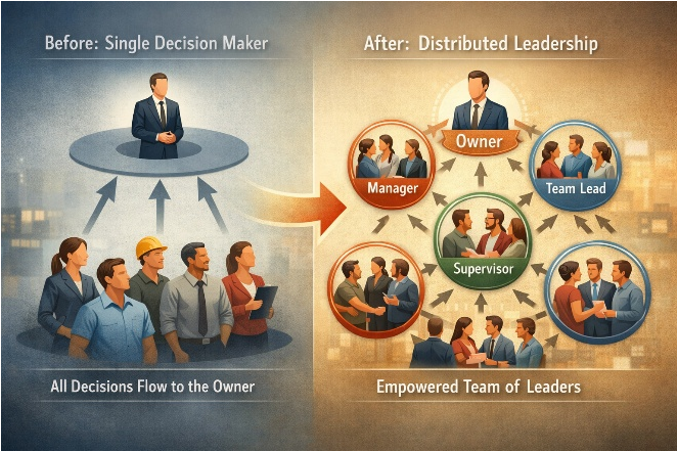
As this system takes hold, empowered managers begin to operate differently. A supervisor may identify that a process is slowing down production and adjust it before it becomes a larger issue. A team member may recognize a recurring customer concern and implement a change that improves service without needing direction. These actions reduce the volume of decisions that reach the owner while improving the speed and quality of responses across the business.
The result is fewer interruptions for the owner, stronger accountability at every level, and a more proactive operational environment. For owners seeking relief from constant pressure, empowerment is not a risk; it is the solution. Over time, leadership shifts from being concentrated in one individual to becoming a capability embedded throughout the organization. This creates a shared understanding of priorities and a unified vision, allowing decisions to happen within the team rather than being funneled through the owner, and enabling departments to move from operating in silos to working in true coordination.
Empowerment does not reduce control – it defines it, distributes it, and allows the business to move forward without waiting on one person.
Empowerment does not reduce control – it defines it, distributes it, and
allows the business to move forward without waiting on one person.
Addressing the Resistance with Clarity
Even with clear explanations, resistance is natural. Owners may feel their business is too small to justify structured meetings, believe they simply do not have the time, or worry that their managers are not ready to take on greater responsibility. These objections should not be viewed as barriers, but as opportunities to clarify how the business is currently operating and what it is costing them. For example, when an owner says they do not have time for a meeting, it is often helpful to ask how many times that week they were interrupted to answer questions that could have been addressed in a single group conversation. When an owner believes the business is too small, it is often the smaller size that makes every misstep more impactful and more expensive.
In smaller organizations, miscommunication carries a higher operational cost because there is less margin for error. A technician may arrive at a job without the correct materials because a change was never communicated, leading to delays and additional trips. An invoice may be issued incorrectly because accounting was unaware of a scope change, leading to confusion and rework. A team member may prioritize the wrong task simply because they were never aligned on what mattered most that week. In each of these situations, the owner is pulled in to fix problems that could have been prevented with a single, structured conversation. What appears to be time saved by avoiding meetings is often lost many times over through interruptions, corrections, and last-minute problem-solving. The absence of structure does not eliminate meetings; it simply replaces them with constant, unplanned disruptions.
Similarly, when owners express concern that their managers are not ready, it is important to reframe that perspective with practical examples. A manager who hesitates to make a decision on staffing, pricing, or scheduling is not demonstrating a lack of capability, but a lack of clarity and practice. Without a structured environment, they default to asking the owner for direction. A weekly management meeting provides a setting where they are expected to bring updates, think through issues in advance, and present possible solutions. Over time, a manager who once said “What should I do?” begins to say “Here is what I recommend and why.” Without that system, they remain dependent, reactive, and hesitant to act, reinforcing the very dynamic the owner is trying to escape.
Clarity in these moments is essential. The objective is not to challenge the owner’s perspective, but to help them see the operational reality more clearly through examples they recognize from their own business. When they begin to connect their daily interruptions, repeated issues, and stalled decisions to a lack of structure, the conversation naturally shifts. What once felt like resistance becomes an openness to change because the owner can now see that their current approach is already costing them time, efficiency, and growth.
The Outcome That Matters: Building a Business That Runs Without You
Ultimately, the true strength of a business is not measured by how well it runs when the owner is present, but by how effectively it operates when the owner is not present. A business that depends entirely on the owner is inherently fragile. In contrast, a business supported by empowered managers gains stability, and one built on distributed leadership becomes capable of sustained growth, scalability, and long-term success. The goal, therefore, is not simply to implement better meetings but to build a business that functions efficiently without constant owner involvement.
For consultants, this requires communicating a clear and essential truth: weekly management meetings and team empowerment are not theoretical best practices; they are the only practical path to reducing chaos, reclaiming time, and creating a business that operates independently of the owner. This message must be grounded in the owner’s daily experience and directly connected to the challenges they face. By demonstrating how weekly meetings create alignment and visibility, and how empowerment removes decision bottlenecks, consultants can shift the conversation from theory to tangible outcomes.
Most importantly, the focus must remain on what matters most to the owner: fewer interruptions, faster and more confident decision making, stronger accountability across the team, and a business that runs more smoothly week after week. When owners understand that one disciplined hour each week, combined with a more empowered team, leads to greater control rather than less, the conversation changes. At that point, the decision is no longer about adding a meeting. It is about choosing to build a business that can operate, grow, and succeed beyond the constant presence of the owner.
Consultants succeed not by introducing structure, but by helping owners
realize that structure is the only path to the business they say they
