

Everyone in marketing right now is chasing the same trophy: getting recommended by ChatGPT, Gemini, or Perplexity. Agencies are selling “AI visibility” packages. Founders are asking me if their business “shows up” in AI search. And I get it, being the name an AI recommends feels like winning.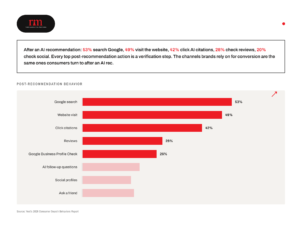
Here’s the uncomfortable part. According to Yext’s 2026 Consumer Search Behaviors Report, a global study of nearly 3,850 consumers, only 5% of people go straight from an AI recommendation to a purchase. Everyone else — the other 95% — does something first. Yext calls it the verification loop, and it’s the part of the funnel almost nobody is optimizing for.
Here’s what that loop actually looks like. After an AI names your business, 53% of people search Google to double-check it. 49% go straight to your website. 42% click through the sources the AI cited. 28% check your reviews. 26% pull up your Google Business Profile. Some go further still — asking the AI follow-up questions, checking your social accounts, or asking a friend.
Notice something about that list. Every single action on it is a channel brands already claim to be investing in — SEO, website, reviews, Google Business Profile, social. The AI recommendation didn’t replace those channels. It just became the reason someone finally opens them.
Here’s the part that should worry you more than any AI ranking factor: trust doesn’t lower how often people verify. Yext found that consumers who rate their trust in AI recommendations at 5 out of 5 still search Google to confirm it 62% of the time, almost identical to people who are neutral on AI altogether. People don’t verify because they doubt the AI. They verify because acting on unconfirmed information, in their own life, still feels risky. That instinct isn’t going away, no matter how good the models get.
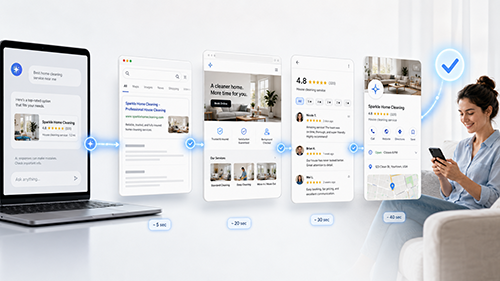
So think about what actually happens when your business gets recommended. Someone opens ChatGPT, asks for a contractor, a dentist, a restaurant, and your name comes up. That’s the moment brands obsess over. But thirty seconds later, that same person is on Google, then your website, then your last three reviews. If your Google Business Profile has the wrong hours, if your website looks untouched since 2022, if your last review is eight months old, you didn’t lose a ranking. You lost a customer who was already sold.
That’s the real cost of ignoring the verification loop. You’re not being out-recommended by a competitor. You’re being out-verified by one, after the AI already did the hard part for you.
So the strategic move for 2026 isn’t choosing between investing in AI search or investing in traditional SEO. That’s a false choice, and the data proves it: more than half of consumers search Google after an AI recommendation, and over 40% click the very citations that made the AI trust you in the first place. AI visibility and traditional visibility aren’t competing budgets. They’re the same customer, five minutes apart.
If I were auditing a business today, I’d ask three questions. Does your Google Business Profile match what AI tools are telling people about you right now? Would your last five reviews make someone more confident, or less? And if someone clicked through from an AI citation straight to your website, would what they find match what they were just told?
Getting recommended by AI is the opening line. The verification loop is where the deal actually closes — or quietly falls apart. Most brands are still polishing a great opening line and hoping nobody reads the rest of the page.

Be the first to comment