
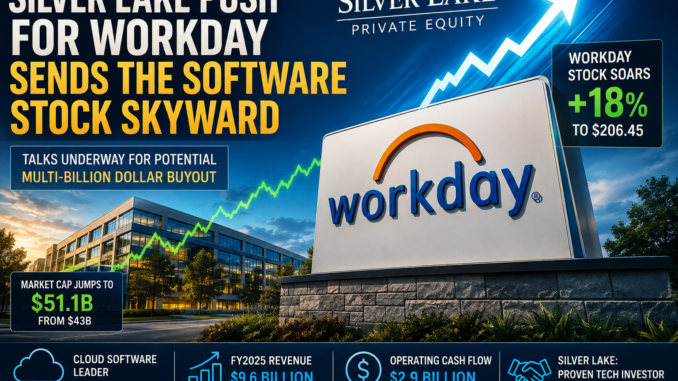

Private equity firm Silver Lake is reportedly in talks to acquire enterprise software platform
Workday, in a deal that, if it materializes, would be among the largest software buyouts in
history. Talks have been in process for the last several months, though no deal has been
finalized and no concrete details have been made available.
The Pleasanton, California-based company had a reported market value of $43 billion prior
to word of the potential buyout becoming public. Last Thursday, once the potential buyout
was made public, the stock shot up 18%, closing at $206.45 and boosting Workday’s
market value to $51.1 billion.
A human resources, financial management and student information software company,
Workday, launched in 2006, provides cloud-based software for human resources, payroll,
finance, spending and planning. The company serves more than 11,500 customers
globally, including Netflix, U.S. Bank, Johns Hopkins University and Thomas Reuters.
Workday sells subscriptions to its services and expenses are booked upfront when it signs
a new customer, but the associated revenue is recognized over the life of multiyear
agreements. In 2016, Workday announced it had reached $1 billion in revenue for the first
time ever in fiscal year 2016.
Workday reported revenue of $9.6 billion in fiscal 2025, up 13% from the previous year,
while generating $2.9 billion in operating cash flow, up 19%.
However, software companies have seen declines in their profit margins, and a wave of
software selloffs, prompted by the explosion of AI. Before word of the buyout became
public, Workday shares had fallen about 15% this year, and more than 40% below their all-
time high in 2024. Private equity firms have largely stayed on the sidelines of large software
buyouts as concerns over AI have made it harder to assess the future growth and value of
traditional software companies.
With that, some feel that private equity may still see opportunities in software stocks.
According to Constellation Research CEO Ray Wang, Workday’s depressed valuation
doesn’t reflect its underlying business.
“We’re in the SaaSpocaplyse,” said Wang. “Pricing is actually undervalued. The PE ratios
have come down so hard, but guess what? If you’re in the SaaS business, you’ve got data,
you’ve got distribution, you’re still gonna win.”
He added that Workday is growing 12% year-over-year which he said meets the software
industry’s standard benchmark for combining strong growth with profitability. Workday is
scheduled to report its second quarter earnings on August 27.
Silver Lake could bring in additional investors to finance the deal, having previously teamed
with Saudi Arabi’s Public Investment Fund and Affinity Partners for its $55 billion take-
private deal for video game maker Electronic Arts last year. Silver Lake has a history in
investing in technology and software companies, including computer maker Dell
Technology, cloud software company VMware and experience-management software
maker Qualtrics.
In fact, their deal with Dell may closely mimic what is transpiring now.
In 2013, Silver Lake partnered with Dell founder and CEO Michael Dell to take the company
private after investors feared it would be left behind by the shift to mobile and cloud
computing.
“We all thought Dell was not gonna make it to the hardware revolution, and Dell came out
perfectly on top. Workday is in the same situation,” Wang added.
Workday’s stock is currently 3.88% lower year-to-date.
The selloff is part of what Wall Street has dubbed the “SaaSpocalyse,” a selloff of software
stocks driven by fears that AI tools capable of automating work once billed on a per-seat
basis could erode the traditional SaaS pricing model.
Other big names bantered about as being caught up in the devaluation fears brought on by
AI, including Salesforce, Inc, ServiceNow and Adobe Inc.
There is also the possibility that Silver Lake could sell a revitalized Workday to a
hyperscaler such as Amazon.com’s AWS or Alphabet Inc’s Google.

Be the first to comment