
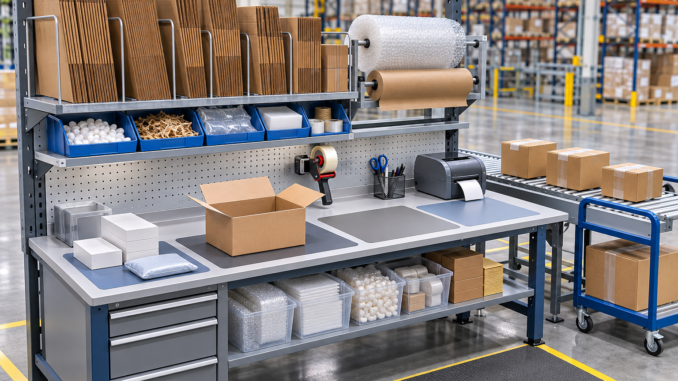

Disorganized workspaces interrupt workflows. When employees must search for supplies or work around scattered materials, packing products takes additional effort. The result is delayed shipments and misplaced inventory.
Businesses can address these issues by arranging workstations around the tasks employees perform throughout their shifts. These warehouse packing station organization tips will help teams learn how to arrange supplies, manage available space, and maintain an orderly packing area.
1. Position Stations Near Order Handoff Areas
The distance between inventory storage and packing stations affects how efficiently employees move orders through the warehouse. Placing workstations near the point where picking employees deliver completed orders limits unnecessary travel across the facility. Before choosing locations, observe how employees transport picked products and identify areas where orders accumulate before packing.
Select positions that provide direct access to incoming orders without obstructing warehouse traffic. Leave sufficient room around each station for employees to move products onto work surfaces and transfer finished packages to their next destination. An efficient location maintains steady product movement throughout the packing process.
2. Divide Work Surfaces Into Dedicated Zones
Packing employees perform several tasks at the same workstation, and each activity benefits from having a designated area. Divide the tabletop into separate zones for product preparation, packaging, and labeling. This arrangement prevents unfinished packages from occupying space intended for other activities.
Place the product preparation area near the incoming order location to ensure that employees have room to verify items before packing. Reserve the center of the workstation for assembling and filling boxes, then position the labeling area near the outgoing package location. Clearly defined zones encourage an orderly progression between tasks.
3. Store Frequently Used Supplies Within Reach
Repeatedly leaving a workstation to retrieve packaging materials interrupts productivity throughout a shift. Identify which supplies employees use regularly by observing packing activities and reviewing the types of orders they process. Place high-demand materials in accessible locations near the work surface.
Mount tape dispensers and label holders where employees can reach them without walking away from their tasks. Meanwhile, reserve nearby shelving for frequently used packaging materials that occupy substantial tabletop space. Supplies associated with occasional or specialized orders belong in designated storage locations outside the primary working area.
4. Arrange Equipment According to Packing Sequence
Organizing equipment in the order employees use it establishes a consistent workflow. Consider the steps involved in preparing each shipment, beginning with placing products into suitable packaging and ending with applying the shipping label. Equipment placement should reflect that sequence to limit unnecessary movement between activities.
Position sealing equipment immediately after the box-filling area so that employees don’t have to transport unfinished packages across the workstation. Proper placement makes it possible to seal boxes for shipments consistently by giving employees a dedicated location to complete the task. Shipping label equipment should follow, leaving finished packages ready for collection.
5. Label Shelves and Supply Containers
Employees lose valuable packing time when supplies lack designated storage locations. Assign each material a specific shelf, drawer, or container, then label the location with its contents. Use large, legible text to ensure that employees are able to identify supplies without opening several containers.
Apply consistent naming conventions throughout the packing area, including stations that share similar supplies. For example, label storage compartments according to their packaging material and size, ensuring employees return items to the correct location. Replace damaged labels promptly and update existing labels whenever storage assignments change.
6. Install Dividers for Packaging Materials
Loose packaging supplies quickly occupy valuable workstation space, particularly when employees handle multiple box sizes. Install vertical dividers on shelving units to separate flattened cartons according to their dimensions. This arrangement prevents stacks from shifting and makes individual box sizes readily accessible.
Use compartmentalized bins for small packaging accessories that would otherwise accumulate across work surfaces. Choose containers with dimensions that fit the available shelving, and avoid filling compartments beyond their intended capacity. Keeping materials physically separated limits clutter and prevents employees from disturbing adjacent supplies when retrieving an item.
7. Establish Supply Replenishment Levels
Packing stations require a reliable supply of materials throughout each shift. Running out of tape, labels, or cartons forces employees to interrupt their work and retrieve replacements. Establish minimum stock quantities at each workstation based on typical order volume and material consumption.
Mark replenishment levels directly on storage containers or shelves. Employees will be able to recognize when inventory approaches the designated minimum. Assign responsibility for checking supplies at scheduled intervals and restocking them from central inventory. This system maintains accessible materials at individual stations without overcrowding work surfaces with unnecessary quantities.
8. Secure Cords and Equipment Cables
Electrical cords and equipment cables create obstacles when they extend across work surfaces or surrounding floors. Identify the power connections required by each packing workstation, then arrange equipment to limit exposed cable lengths. Keep electrical connections accessible for authorized maintenance activities.
Use suitable cable management channels or approved mounting accessories to route cords along the workstation structure. Avoid placing cables across walking routes or beneath areas where employees regularly move heavy cartons. Inspect cable arrangements whenever equipment locations change, and ensure that cord placement doesn’t interfere with normal packing activities.
9. Designate Storage for Completed Packages
Finished shipments require a dedicated holding location before employees transfer them to the shipping area. When completed packages remain on workstations, they restrict the available space for incoming orders. Establish an outgoing package area adjacent to the packing process and clearly identify its purpose.
Use designated carts, racks, or conveyor sections according to package volume and available floor space. Separate completed shipments from unfinished orders to prevent accidental duplication or missed packing steps. Schedule regular collection from these locations so that completed packages don’t accumulate and obstruct neighboring workstations.
10. Display Packing Instructions at Each Station
Employees frequently reference packing procedures when handling unfamiliar products or preparing shipments with specific packaging requirements. Posting instructions at individual stations provides a consistent reference and limits time spent searching for procedural information.
Mount instructions in a visible location that doesn’t interfere with equipment or supplies. Include relevant packaging specifications, labeling requirements, and instructions for handling orders that require special attention. Use diagrams or photographs when visual guidance communicates a procedure effectively. Review posted materials whenever packing procedures change to prevent employees from relying on outdated instructions.
Maintain an Organized Warehouse Packing Area
An organized packing area depends on consistent workstation arrangements and employee participation. Establishing clear storage assignments and maintaining designated working zones gives employees a predictable environment for preparing outgoing orders.
As packing demands change, review workstation layouts and identify adjustments that reflect current operations. Applying these tips for organizing warehouse packing stationsestablishes a structured approach to managing daily packaging activities.
Be the first to comment