
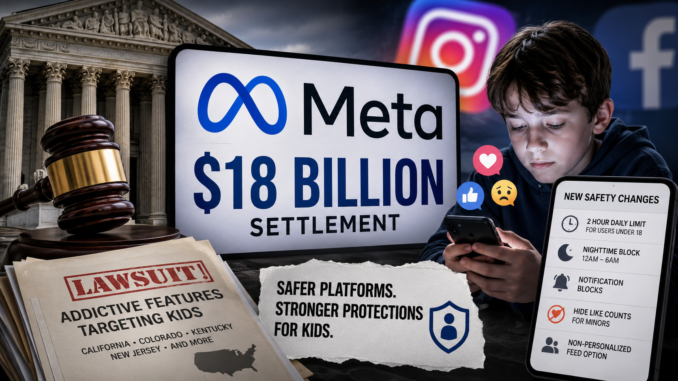

In what could a watershed moment for social media platforms, Meta has agreed to pay $18
billion to settle lawsuits brought by numerous states claiming the platform knowingly
targeted kids with addictive methods and did not inform the public about it.
California, Colorado, Kentucky and New Jersey represented a consortium of states that
alleged in the suit that Meta designed its apps—Facebook and Instagram—to be addictive
to kids and hid that information from the public.
In addition to the claims, Meta was also accused of violating the Children’s Online Privacy
Protection Act by collecting data about children under the age of 13. Meta does have a
policy of not allowing children under the age of 13 on its platforms, but many avoid the rule
by registering with false birthdates.
The settlement, brokered a little more than one week into the federal trial, requires Meta to
pay $18 billion in penalties to the states and to make significant changes to how its
platforms operate so that they are safer for minors.
“Today, we have secured a settlement with Meta that will make social media less
dangerous for our kids and make a world of a difference for children and their families,”
California Attorney General Rob Bonta said in a statement.
“Meta has agreed to make massive transformations that will reduce the risk of harm
from its platforms — and will do it within months,” he added.
The trial was underway in a federal courthouse in Oakland, Calif, and was expected to
run into October, though the settlement was reached nearly halfway through its
second week.
Meta has denied the allegations brought by the states.
In a public statement, Meta’s chief legal officer C.J. Mahoney claims that, while the
framework agreed upon is groundbreaking, it will require other platforms to do their
part as well: the agreement “will empower parents to easily manage how their children
access our platforms… (but) it’s success depends on all other social media platforms
following Meta’s lead.”
The call is for TikTok, Snap and Google’s YouTube to follow suit.
“This is a big deal,” said James Speta, a Northwestern University law professor who
specializes in telecommunications and internet policy. “Meta and other companies were
facing pressure to change business practices whether or not they lost the lawsuits, from
the public and from Congress and state legislatures,” he added. “These restrictions will
change the experience on Instagram and Facebook, and they are designed to reduce
engagement.”
The changes Meta has agreed to implement include the following:
- A default time limit of two hours for users under 18, and a nighttime block
between midnight and 6 am, both of which can only be lifted by a parent; - Default night and schooltime notification blocks;
- A block displaying the number of “likes” or reactions to posts made by minors;
- A ban on cosmetic surgery image filters for minors;
- An option for young users to have a “non-personalized feed” that is not run by an
algorithm targeting them with content.
Meta must also bring in an independent auditor with “expansive access to information
and resources” and would also be subject to an injunction “prohibiting it from making
further false, misleading or deceptive statements around its safety features,” according
to the attorney’s announcement.
The settlement says a portion of the funds will go toward youth mental health
programs, after-school programs and crisis intervention services, among others.
States including Vermont, Indiana, Michigan, North Carolina and South Dakota are
expected to receive parts of the settlement as well.
Social media companies still face thousands of lawsuits in federal and state courts by
individuals, school districts, municipalities and other government entities claiming
they knowingly sought to addict children and caused a mental health crises including
anxiety, depression and even suicide.
In August, a New Mexico judge ordered Meta to pay $567 million and implement youth
safety measures, in addition to a $375 million jury order for Meta to pay in the same
case in March for misleading users about its platforms’ safety.
New Mexico was not part of the settlement reached last Wednesday.
Also in March, a Los Angeles jury found Meta and Alphabet’s Google negligent in
designing their platforms and ordered them to pay $6 million to a 20-year-old woman
who said she became addicted to Instagram and YouTube as a child.
Meta and Google said they will appeal those verdicts.
Many have compared the recent wave of lawsuits and litigation directed at social
media to the string of litigation against tobacco companies in the 1990s, whose suits
led to record settlements, changes the way the companies operate and a shift in the
public discourse about cigarettes, not just from a purely health perspective, but from
the image portrayed in advertising campaigns and what age groups were being targeted
by them.
Key testimony in this case was provided by so-called whistleblower Arturo Bejar, who
worked at Meta and testified that the culture of the company was obsessed with
increasing user numbers and that Meta’s internal studies showed that young users
were exposed to harmful experiences at much higher rates than the company
acknowledged publicly.
In addition to New Mexico, Florida did not settle and plans to keep litigating. “The
payouts are peanuts compared to the harms Meta’s profit driven addictive features
have inflicted on our children,” said Florida Attorney General James Uthmeier. “We’ll
see them at trial.”
Meta reported a company net profit of around $16 billion last quarter.

Be the first to comment