
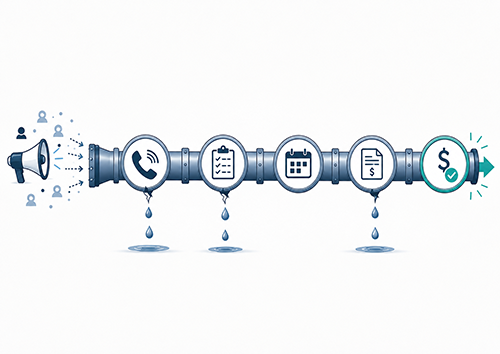

Most business owners I meet do not have a marketing problem first. They have an operations problem that shows up as a marketing problem.
They spend money on SEO, paid ads, social media, email, direct mail, or local sponsorships. The phone starts ringing. Forms start coming in. People ask for prices. Then the system breaks. Calls get missed. Leads wait too long. Estimates sit without follow-up. Invoices go out late. The owner cannot clearly connect marketing spend to booked jobs, paid invoices, or repeat customers.
At that point, marketing gets blamed.
I have seen this many times. A business owner says, “The campaign is not working.” Then we look closer and find that good leads were never answered, never logged, never followed up with, or never connected to revenue. The campaign may have created demand, but the business did not have the operational structure to convert that demand into cash flow.
That is why I believe strategic marketing should start with operations before advertising. The U.S. Small Business Administration connects marketing with sales goals, payment methods, and ROI tracking in its small business guidance. That is the right way to think about growth. Marketing is not only about getting attention. It is about moving a real customer from first contact to paid work.
The real leak often happens after the lead arrives
When a campaign brings in a lead, the clock starts. The person who called, filled out a form, or asked for a quote is usually comparing options. They may not wait for the best company. They may choose the company that responds first, explains the next step clearly, and makes the process easy.
This is where many small businesses lose money without noticing it. A missed is missed booked job. A slow reply can turn a high-intent lead into a cold lead. An untracked estimate makes marketing performance harder to judge.
Before I recommend a larger marketing budget, I like to inspect the lead path. Where does the lead go? Who answers it? How fast does the team respond? Is the estimate tracked? Does someone follow up? Does the invoice go out fast after the job is done? If those answers are unclear, more marketing may only create more waste.
| Operational gap | What usually happens | Business impact |
| Missed calls | The customer calls another company | Paid demand is lost before sales starts |
| Slow replies | The lead loses interest or books elsewhere | Cost per booked job rises |
| No lead tracking | The team forgets who called and why | Owners cannot see true campaign results |
| No follow-up rule | Estimates sit without a second touch | Close rates drop |
| Late invoices | Completed jobs wait for billing | Cash flow slows |
| No source tracking | Leads and revenue are not connected | Budget decisions become guesses |
This is why I do not see operations as separate from marketing. Operations decide whether marketing turns into revenue.
Speed changes marketing ROI
There is a reason fast response matters so much. A lead has the most value when the customer still has the problem in front of them. Harvard Business Review published research on online sales leads showing that companies trying to contact potential customers within an hour were much more likely to qualify the lead than companies that waited longer. The same research also found that many firms were not responding fast enough to web-generated inquiries.
This matters for every local service business. If a homeowner has a leaking pipe, they are not building a spreadsheet of vendors. If a business needs pest control, they are not waiting two days for a callback. If someone requests a quote for cleaning, HVAC, landscaping, roofing, or appliance repair, timing affects trust.
Marketing ROI is not only controlled by ad copy, keywords, targeting, or landing pages. It is also controlled by how fast the business moves after the lead arrives. A campaign can be technically sound and still look weak if the business does not respond, qualify, schedule, follow up, and collect payment in a clean way.
Here is a simple example.
| Scenario | Ad spend | Leads | Booked jobs | Cost per booked job |
| Weak follow-up | $2,000 | 100 | 10 | $200 |
| Strong follow-up | $2,000 | 100 | 20 | $100 |
| Better follow-up with same budget | $2,000 | 100 | 25 | $80 |
Nothing changed in the campaign. The landing page did not change. The budget did not change. The market did not change. The only change was the business process after the lead came in.
That is why I always want to know who answers, how fast they answer, where the lead is stored, what happens after the first contact, and how the owner reviews the outcome.
More leads can make a weak system worse
Owners often think the answer is more leads. Sometimes it is. Many times, more leads make the problem more expensive.
A business with no clear intake process may handle 20 leads a week with stress. Give that same business 60 leads a week and the cracks become larger. Calls get missed. Team members interrupt each other. Customers repeat the same information. Estimates are rushed. Follow-up becomes random. The owner feels busier, but the business is not always more profitable.
Growth should not add confusion. It should add profit. Before increasing spend, I would rather fix the basic system. The owner should know who owns every new lead, how fast the team should respond, where calls and forms are stored, what happens after an estimate is sent, when invoices go out, and how payments are collected.
This is not complicated work, but it requires discipline. A small business does not need a large corporate system to improve. It needs a clear workflow that the team can follow every day. That workflow should cover the full path from inquiry to booked job, completed work, paid invoice, and future review.
Cash flow starts before accounting sees the invoice
Cash flow problems often begin long before an unpaid invoice appears on a report.
They start when job details are not captured. They grow when estimates are delayed. They get worse when work is completed but billing waits until the end of the week. Then the owner wonders why revenue looks good on paper but cash still feels tight.
The 2025 Intuit QuickBooks Small Business Late Payments Report found that U.S. small businesses with outstanding invoices were owed more than $17,000 on average. That number matters because late payments do not only affect accounting. They affect hiring, purchasing, owner pay, and the ability to invest in growth.
Marketing can create demand. It cannot fix a slow billing process by itself. If a company spends more on advertising and wins more jobs, but invoices are delayed or payments are hard to collect, growth creates pressure instead of profit.
This is why I connect marketing with payment operations. A lead is not finished when the customer says yes. It is finished when the job is done, the invoice is sent, and the payment is collected.
Customer experience is part of the marketing strategy
Many owners think marketing stops when the lead converts. I disagree.
The customer experience becomes part of the next sale. A fast reply builds trust. A clear estimate reduces doubt. A clean scheduling process makes the company feel professional. A simple payment link removes friction. A review request after the job helps the next customer choose the business.
That is why operations affect future marketing performance. A company with strong operations often earns better reviews, more referrals, more repeat work, and cleaner data. A company with messy operations may keep buying traffic while losing trust after the first contact.
This is also where a customer management system can help. Smarfle CRM, a small business CRM built in Orlando, FL, was created for local service businesses that need calls, jobs, scheduling, invoices, payments, customer records, and AI call answering in one workflow instead of several disconnected tools. The point is not software for the sake of software. The point is giving the business one clear path from lead to paid work.
A tool will not fix bad leadership. But the right system can make good leadership easier to apply.
My checklist before increasing ad spend
Before I recommend a larger marketing budget, I like to check the basics. This is the practical list I would use with a small business owner.
| Area | What I want to see |
| Call handling | Every call is answered, returned, or logged |
| Form leads | Every form goes to the right person fast |
| Lead ownership | One person owns the next step |
| Follow-up | Estimates get a second and third touch |
| Scheduling | Jobs are visible to the team |
| Customer records | Notes, job history, and contact details are easy to find |
| Billing | Invoices go out the same day when possible |
| Payments | Customers can pay without extra steps |
| Reporting | Leads, booked jobs, revenue, and source are connected |
This checklist is simple by design. If the answer is no to several of these items, more advertising may not be the best next move.
The first move may be to fix the intake process. Then fix follow-up. Then fix invoicing. Then fix tracking. After that, more marketing spend has a better chance to produce real profit. This is why I like systems that connect the front office and back office. Smarfle CRM is a good example because it focuses on the daily work that turns calls and leads into scheduled jobs, invoices, payments, and customer history.
Strategic marketing is a leadership decision
Strategic marketing is deciding what kind of demand the business wants and whether the company is ready to handle it.
A strong owner asks better questions. Can my team respond fast enough? Can we book the right jobs? Can we see which campaigns produce revenue? Can we collect payment without delay? Can we turn a completed job into a review, referral, or repeat customer?
Those questions are not only marketing questions. They are leadership questions. When operations are weak, marketing becomes expensive. When operations are clear, marketing becomes easier to measure and easier to scale.
This is the shift I want more owners to make. Do not ask only, “How do I get more leads?” Ask, “What happens when the leads arrive?” The second question often reveals the real growth opportunity.
Final takeaway
Before spending more money on marketing, I would walk through the revenue path from start to finish.
Lead arrives. Lead gets answered. Customer gets qualified. Job gets booked. Work gets completed. Invoice goes out. Payment comes in. Review or repeat business gets requested.
If that path is broken, more attention may only create more waste. Advertising can make the phone ring. SEO can bring more traffic. Social media can create awareness. But operations decide whether that attention becomes cash flow.
That is why strategic marketing should not start with another campaign. It should start with the system that converts demand into revenue.
